
Jaipur photo spots range from the honeyed sandstone ramparts of Amber Fort glowing at dawn to the 953-window lattice of Hawa Mahal, and from the perfectly symmetrical stepwells of Panna Meena ka Kund to the blazing colour corridors of Patrika Gate. Most of them reward photographers who show up at the right hour — and the best time to do that is between October and March, when the air is crisp, the light is warm without being brutal, and the pale-pink facades of the Old City catch the early sun at exactly the angle that makes Jaipur look like a painting.
This guide was written with input from our Jaipur photographers who shoot here year-round — an honest insider map of where the light lands, when the crowds clear, and what the travel blogs won’t tell you.
1. Hawa Mahal: The Shot Everyone Gets Wrong
The Palace of Winds is Jaipur’s most recognisable landmark and, inevitably, its most mishandled photo opportunity. Standing directly in front of it with a phone camera at noon produces the same washed-out, crowd-filled frame that millions of visitors already have.
Shoot from the Rooftop Cafe Opposite — Not from Street Level
The best angle on Hawa Mahal is not from the street — it’s from the rooftop cafes directly across on Hawa Mahal Road, most notably The Tattoo Cafe and a handful of neighbouring rooftops. From there, you get the entire five-storey lattice honeycomb in frame without the chaos of the street below, and in the early morning between 7:30 and 9:00 AM, the eastern light falls directly onto the pink facade before it bleaches out. Arrive before 8 AM on a weekday for the cleanest sightlines. If you want to shoot from inside the palace itself, the windows and jharokhas create natural frames for portraits — but entry costs ~$2.10 (₹200) for foreigners and cameras are restricted to phones only inside. The exterior rooftop shot is always the stronger image.
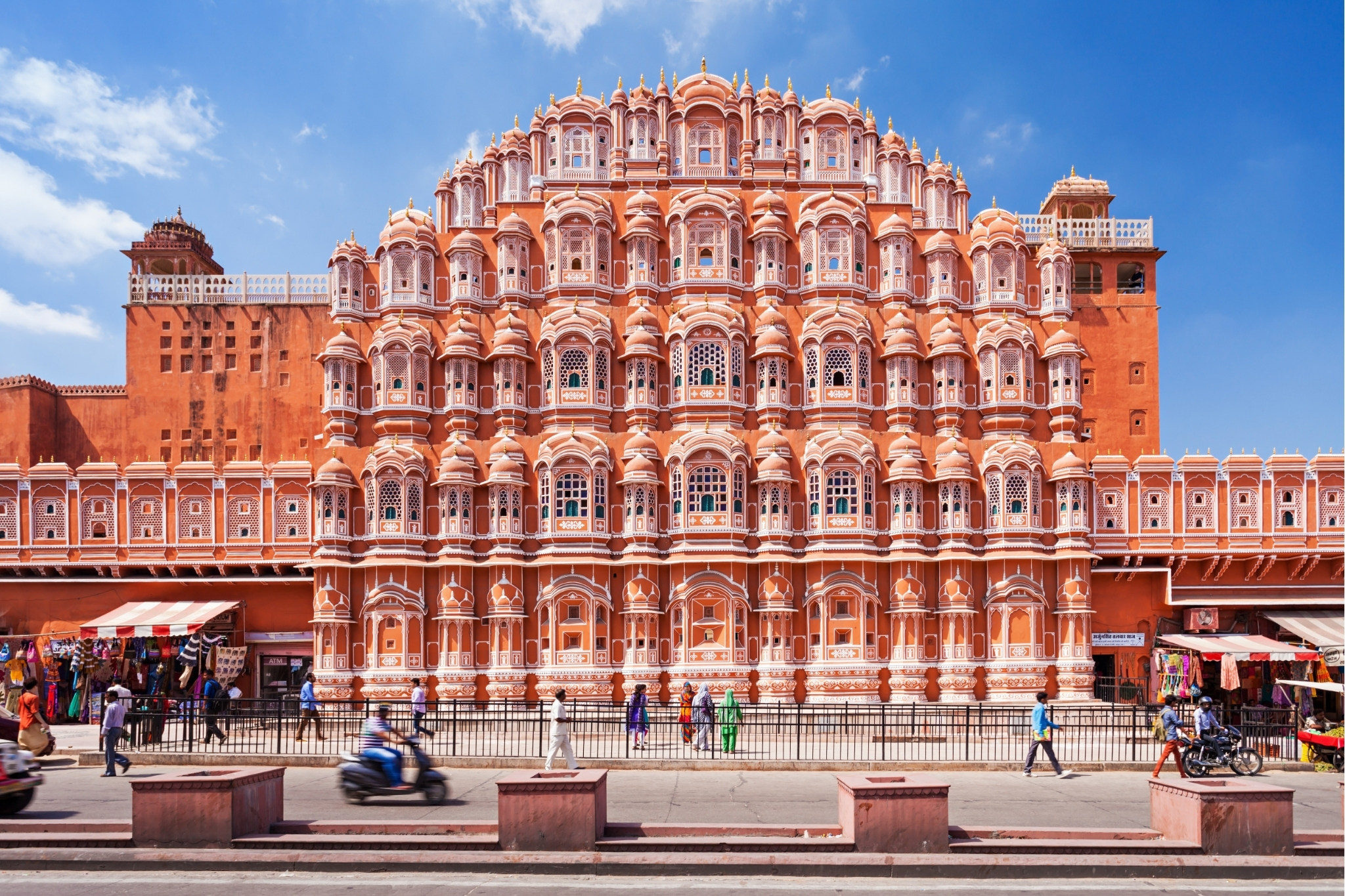
“Most people photograph Hawa Mahal from the middle of the road and wonder why the image looks flat. You need elevation and soft morning light. From the rooftop opposite at around 7:45 AM in November, the building looks like it’s made of lace — the shadows fall perfectly into every carved recess.”
— Anshul, local photographer in Jaipur
2. Amber Fort: Where the Sandstone Turns to Gold
Amber Fort is the most architecturally layered of all the Jaipur photography locations — a hillside complex of honey-coloured sandstone and white marble courtyards that changes character completely depending on when you arrive. Most visitors see it in mid-morning chaos. Our photographers know exactly how to avoid that.
Be at the Gate at 8:00 AM — It Opens and the Light Is Perfect
Amber Fort opens at 8:00 AM, and the first hour is transformative. The Ganesh Pol — the ornate painted entrance gate covered in floral elephant motifs in red, green, and turquoise — is the most photographed element inside the fort, and before the tour groups pour in, you can compose it in almost complete solitude. The sandstone takes on a deep amber-gold colour in the morning eastern light that is entirely gone by 10 AM. For wide compositions, position yourself in the second courtyard (Jaleb Chowk) and shoot back toward the Suraj Pol entrance with the light falling on the lattice screens. For the iconic exterior long shot — the fort cascading down the hillside with the Maota Lake in the foreground — stop on the main Amber road below the fort and shoot from there at golden hour before the gates open. A 50–85mm lens flatters the proportions; ultra-wide distorts the arches.

“The Ganesh Pol entrance is one of those compositions that has been photographed millions of times, and it still stops me. In the first 20 minutes after the fort opens, with the light at that angle, it looks completely different from anything I’ve seen published. That’s the window.”
— Navin, local photographer in Jaipur
3. Panna Meena ka Kund: Jaipur’s Most Geometric Hidden Gem
This 16th-century stepwell near Amber Fort is one of the best-kept photography secrets in all of Rajasthan — a perfectly symmetrical grid of criss-crossing staircases descending into a square well, with warm ochre walls that catch the morning light beautifully.
Shoot from the Top Corners at 8:30 AM for Maximum Symmetry
The mathematics of Panna Meena ka Kund are what make it extraordinary as a best place for photos in Jaipur — the staircases create a perfectly mirrored grid in every direction. The strongest compositions come from kneeling or lying at the corner of the upper level and shooting diagonally down into the well. At 8:30 AM, the sun has risen just enough to illuminate the far wall without blowing out the shadows on the steps. Mid-morning kills the contrast; by 11 AM, flat overhead light eliminates the geometric drama entirely. Entry is free. The stepwell is almost always quieter than Amber Fort, which is 10 minutes away on foot — combine both locations in a single early session. For portrait work, place your subject one-third of the way down the central staircase and shoot from above; the receding pattern of steps creates a natural leading line directly into the frame.

4. Nahargarh Fort: Jaipur’s Best Sunset Panorama
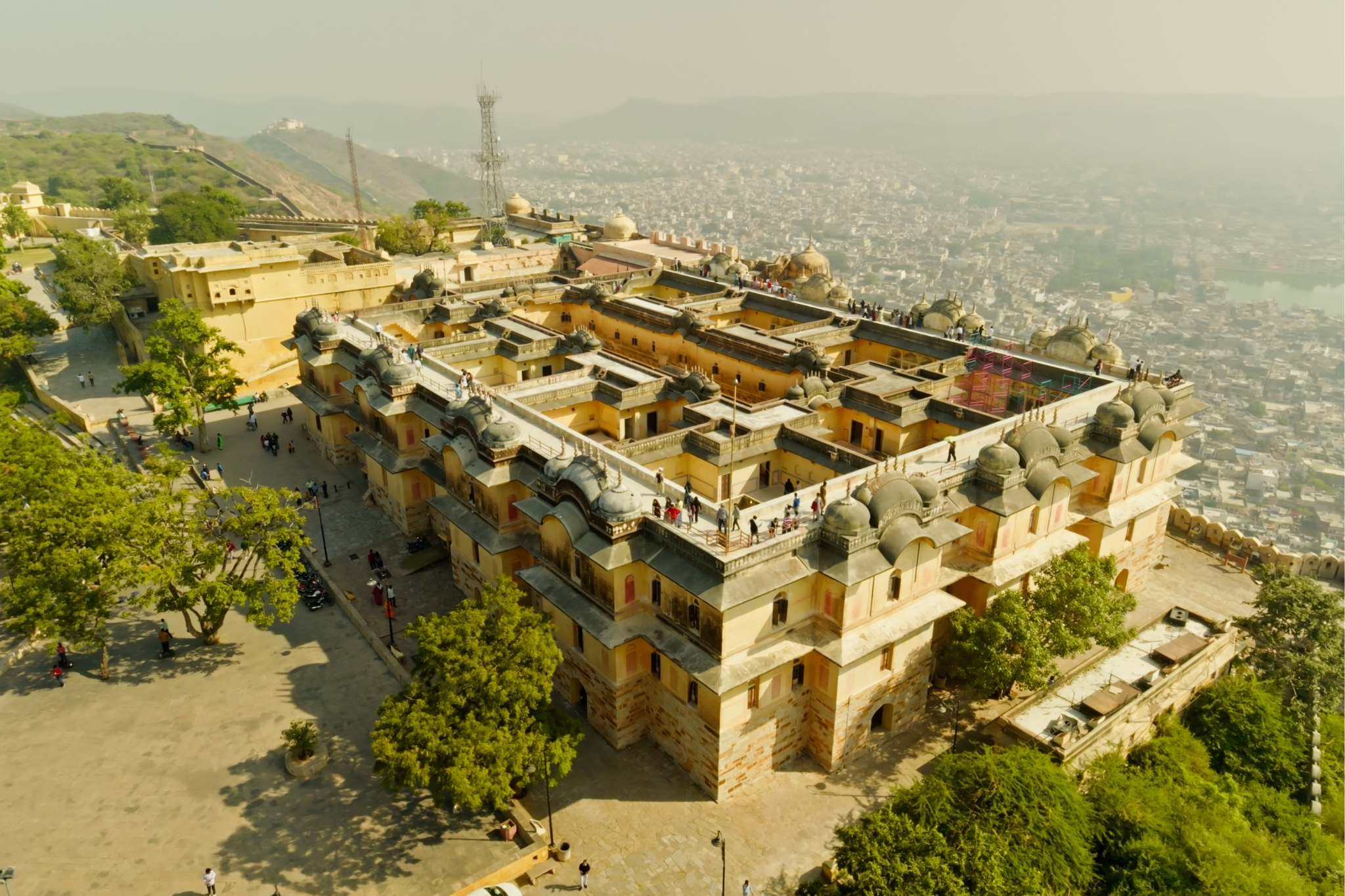
Perched on the Aravalli ridge above the city, Nahargarh Fort was built in 1734 as a royal retreat and commands unobstructed panoramic views across the entire Pink City. It is Jaipur’s definitive sunset photography location — and one of the most consistently underused for sunrise.
Go at Sunset — But Return at Sunrise for the Better Shot
Everyone goes to Nahargarh for the panorama, and they spend the entire visit facing outward. The more interesting photography is inside Madhavendra Bhawan — the palace the maharaja built for his nine queens, each with her own identical two-storey suite arranged so he could visit any one without the others knowing. The rooftop of the Bhawan gives you a completely different image: the inner courtyard’s identical arched rooms repeat in all four directions around you, with the city panorama visible beyond the fort walls in the background. Shoot this from the rooftop at 6:30 AM before the tour groups arrive — the morning light falls into the courtyard at a low angle that picks out the frescoed arches in detail. After that, work your way out to the western ramparts for the city panorama — by then the light is higher and the view is yours. The fort is lit at night between 7 and 10 PM; the illuminated exterior visible from the city below is a strong long-exposure subject from Jal Mahal or the Amber road.
5. Patrika Gate: Jaipur’s Most Instagrammable New Icon
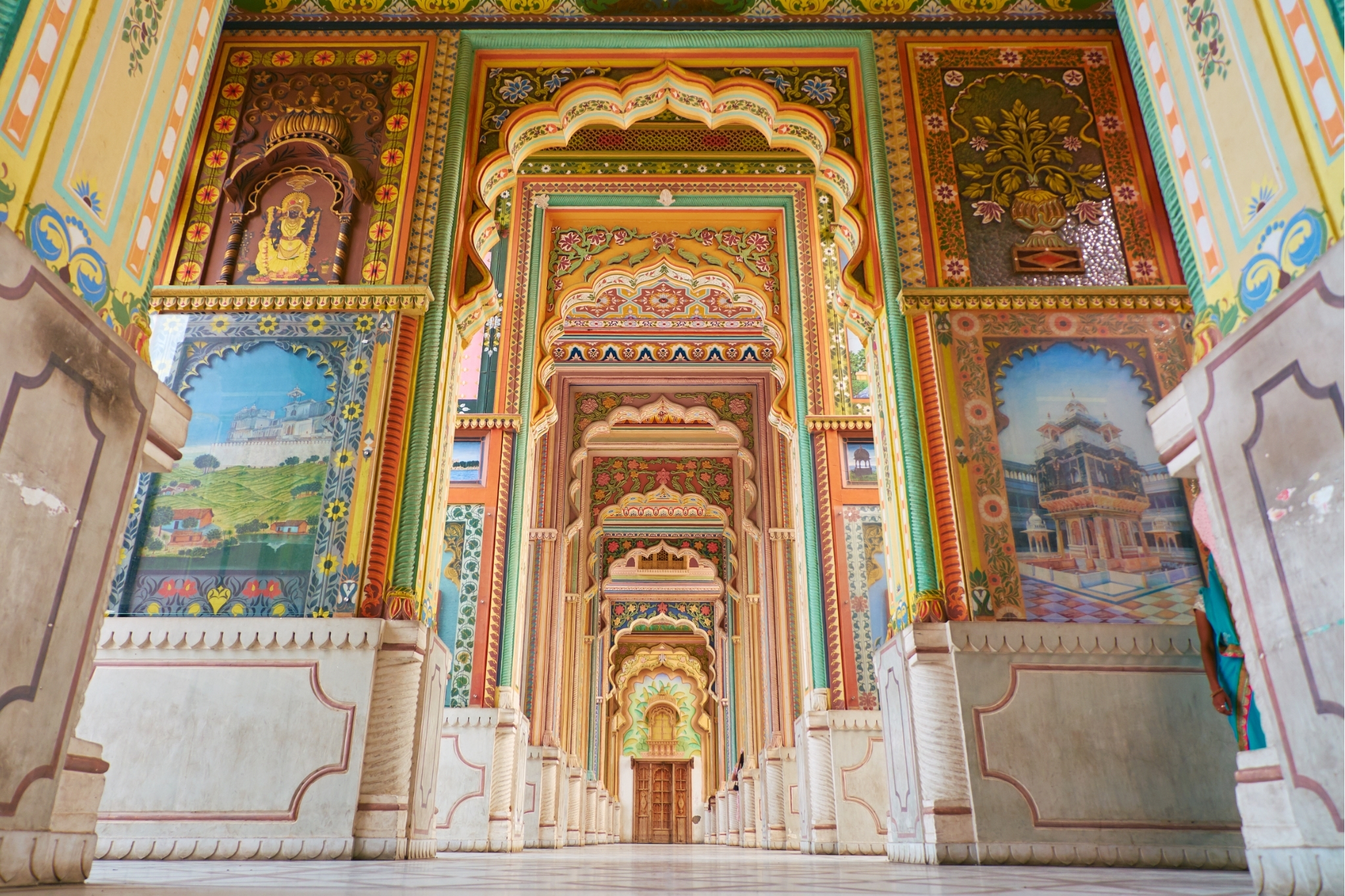
Patrika Gate at Jawahar Circle is a relatively recent addition to Jaipur Instagram spots — an ornate ceremonial gateway covered in painted murals, carved arches, and traditional Rajasthani motifs — and it has rapidly become one of the most photographed structures in the city.
Arrive at Opening and Stand Dead Centre for the Symmetry Shot
The most arresting image at Patrika Gate is the symmetry shot: standing precisely in the centre of the gateway and shooting straight down the corridor of painted arches. This requires nobody else in the frame, which means arriving at or before the site opens, ideally between 7:00 and 8:00 AM. The morning light at that hour is warm and directional, enhancing the deep reds, blues, and golds of the painted surfaces without the midday bleaching that turns everything flat. A wide-angle lens captures the full depth of the arched corridor; a 35mm or 50mm gives cleaner portrait-to-architecture proportions. Entry is free. The surrounding Jawahar Circle park is photogenic in its own right — the green lawns and fountain make a good context shot — but the gate itself is the reason to come. Avoid weekends between 10 AM and 5 PM, when it is extremely busy.
6. City Palace: Courtyard Light and Royal Architecture
Still the official residence of the Jaipur royal family, the City Palace is a sprawling complex of Mughal-Rajput architecture at the heart of the Old City — courtyards, ornate gateways, peacock motifs, and the famous Mubarak Mahal draped in pale marble.
The Pritam Niwas Chowk Doorways Before 10 AM
Most visitors enter through the main Udai Pol gate and head straight for the Pritam Niwas Chowk courtyard — which means they’re all looking at the same four doors at the same time. Enter instead through the Virendra Pol on the Jantar Mantar side, which is consistently less crowded and deposits you directly into the Mubarak Mahal courtyard. Work through the complex toward Pritam Niwas Chowk from the inside out. The key technique here is to shoot each of the four season gates individually — not the courtyard as a whole. Stand directly in front of the Peacock Gate (dedicated to Lord Vishnu, autumn) and fill the frame with nothing but the door. The turquoise, gold, and peacock-blue detail work is extraordinary up close, and it photographs differently from each of the four. The guard stationed at the entrance to Chandra Mahal is known locally as one of the best angle-spotters in the palace — he will show you where to stand for the Chandra Mahal backdrop shot and does it with genuine enthusiasm. Tip him accordingly.

7. Jal Mahal: The Floating Palace at Golden Hour
Rising from the middle of Man Sagar Lake on the road between Jaipur and Amber, Jal Mahal — the Water Palace — is one of Rajasthan’s most dreamlike subjects. The five-storey Mughal palace sits four storeys submerged, with only the top floor and rooftop pavilion visible above the waterline.
The Eastern Lakeshore at 5:45 PM in Winter
You cannot enter Jal Mahal — it is closed to visitors and accessible only by boat on occasional guided trips. All the photography happens from the shore. The eastern shore of Man Sagar Lake, accessible from the main road, gives you the full palace in frame with the Nahargarh hills rising behind it. At 5:45 PM in winter, the setting sun falls on the palace’s warm red sandstone at a low, flattering angle and reflects perfectly in the still water below — particularly beautiful between October and February when the lake level is at its highest after the monsoon. A 70–200mm telephoto compresses the background hills into the frame and isolates the palace against the sky. Arrive 30 minutes before sunset to find your position before the light changes. Sunrise from the western shore produces a silhouette of the palace against a brightening sky — an entirely different image worth the early start.

“Jal Mahal is one of those locations where patience does most of the work. You set up your position early, you wait for the water to go completely still, and then the light does exactly what you hoped it would. The lake reflection doubles the palace — you’re looking at two palaces, one real and one perfect.”
— Anshul, local photographer in Jaipur
8. Johri Bazaar and the Pink City Streets: Street Photography in the Old City
The walled Old City of Jaipur — all of it painted in the distinctive terracotta-pink that gives the city its name — is not one photo spot but an entire district of them. Its markets, chai stalls, textile shops, and temple entrances are where the most authentic and unplanned photography in Jaipur happens.
Johri Bazaar at 7:30 AM Before the Markets Open
Every photographer goes to the main stretch of Johri Bazaar. Almost none of them turn into Gopalji ka Raasta — the narrow lane running off the main bazaar toward Hawa Mahal that is entirely given over to lac bangle makers and Kundan jewellery workshops. At 8:00 AM, the craftsmen are at their benches with the workshop doors open; the light falls in from the lane entrance at a low angle and the interiors are lit by single bare bulbs that create the kind of contrast you’d spend hours setting up in a studio. Ask before shooting — most will say yes, and the images of hands working at lac or setting stones are unlike anything available at the monuments. Two lanes over, Sireh Deori Bazaar near the clock tower sells antique silver at stalls that haven’t changed in decades. The pink-painted archways at the Sireh Deori Gate — the eastern entrance to the old city, directly facing Hawa Mahal — are a strong wide shot in the early morning before the street fills with traffic.

9. Jantar Mantar: Geometry Meets Astronomy
Built between 1724 and 1735 by Maharaja Jai Singh II, Jantar Mantar is a UNESCO World Heritage Site and one of the most photogenic — and most underrated — Jaipur photography locations. It is a collection of 19 monumental astronomical instruments in stone and marble, and the abstract shapes they create are unlike anything else in the city.
Shoot the Samrat Yantra Against the Morning Sky
Everyone photographs the Samrat Yantra — the giant sundial that dominates the complex and appears on every postcard. Fewer than one in ten visitors walk to the Ram Yantra, 50 metres further into the complex: two large open cylinders, chest-height walls, with arc-shaped stone scales radiating outward from the centre like the floor of a compass. At 9:30 AM in winter, the sun is high enough to fall vertically into the cylinders and the scales cast clean parallel shadows across the graduated stone floor. Shot from the centre of the cylinder looking straight down at the radiating lines, it looks like abstract architecture rather than a 300-year-old astronomical instrument. It is also almost always empty. The Jai Prakash Yantra next to it — two hemispherical bowls with a cross of bridges over the top — photographs best from above the rim at the bridge level, looking down into the concave interior with the cross framing the sky.

10. Albert Hall Museum: Blue Hour in the Garden
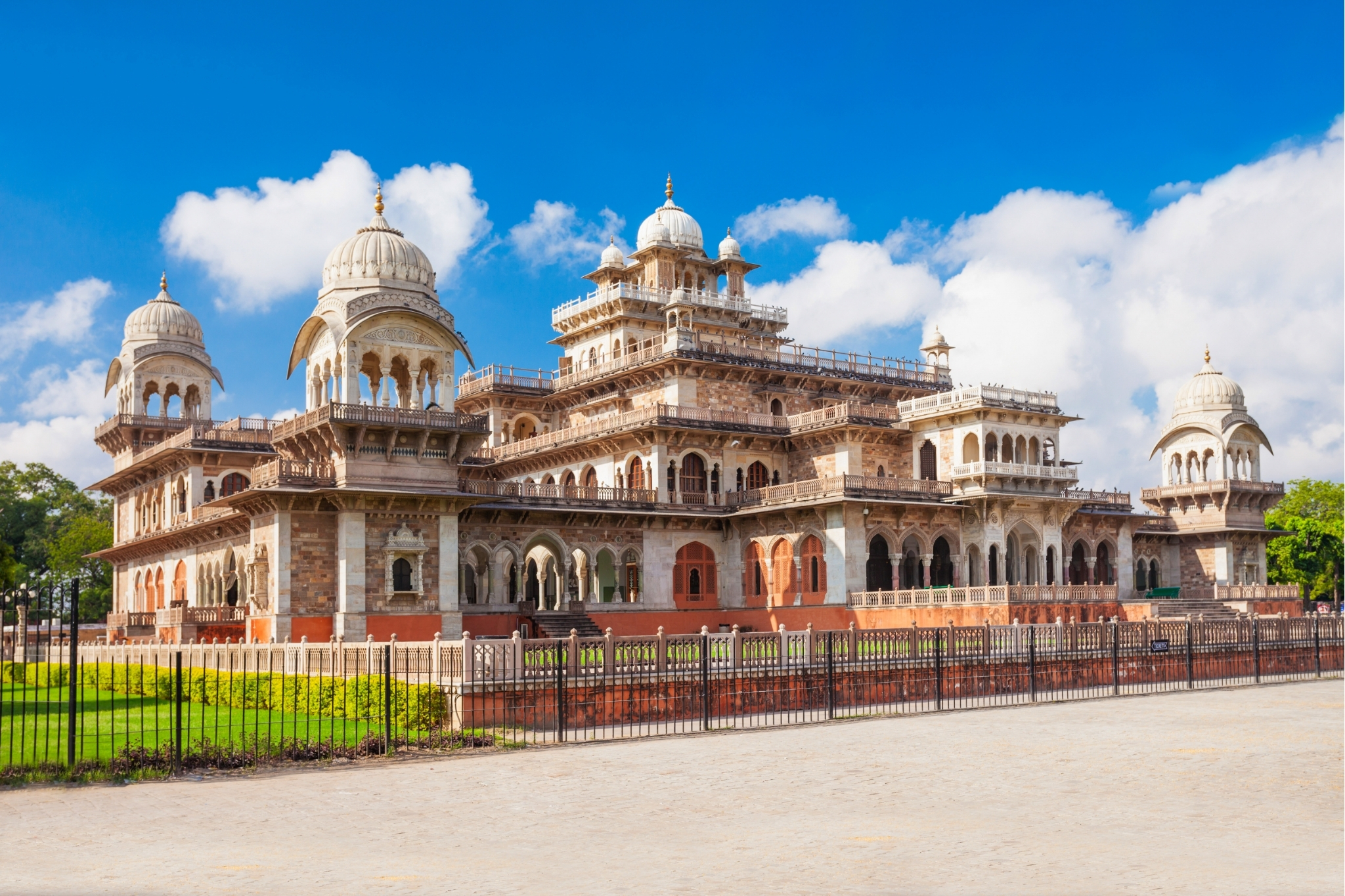
Built in 1876 in a spectacular Indo-Saracenic style for the visit of the Prince of Wales, Albert Hall Museum is one of the most architecturally impressive buildings in Jaipur — and one of the most consistently overlooked by photographers who spend their evenings at Nahargarh instead.
The Facade at Blue Hour, Illuminated Against the Sky
Albert Hall is illuminated after sunset, and the combination of warm building lights against the deep blue sky at blue hour — roughly 20–30 minutes after the sun goes down — produces one of the most dramatic architectural images in the city. Position yourself on the main path leading from the Ram Niwas Garden entrance, shooting straight at the central arch with the symmetrical wings in frame. A tripod is essential; a 35–50mm gives the most natural proportions. The garden gets busy at sunset but thins significantly after 7 PM. The building’s decorative domes, carved balconies, and arched arcades also reward close-up detail shots during the day. Entry to the museum costs ~$3.19 (₹150) for foreigners; the garden and exterior are free.
Best Time of Day for Photos in Jaipur
Getting the timing right matters more at Jaipur photo spots than almost anywhere else in India, because Rajasthan’s dry, clear air means the light shifts with particular speed and the midday sun is punishing on pale stone — turning the city’s distinctive pink facades into flat, bleached surfaces that are almost impossible to expose correctly.
Golden Hour and Season Specifics
Sunrise in Jaipur falls around 7:00 AM in December and January, shifting to around 5:45 AM by June. The post-sunrise golden hour window runs approximately 45–60 minutes and is the optimal time for Amber Fort, Panna Meena ka Kund, Hawa Mahal, and Old City street photography. In the evening, sunset falls around 5:30 PM in December and 7:15 PM in June, followed by 20–25 minutes of blue hour — ideal for Albert Hall, Jal Mahal, Nahargarh Fort panoramas, and City Palace exteriors. Avoid shooting between 10 AM and 3:30 PM year-round: Jaipur’s overhead midday light bleaches sandstone, collapses the shadow detail that gives the city’s carved architecture its depth, and creates harsh downward shadows on faces that no amount of post-processing fully rescues.
The best overall season is October through February. The air is at its clearest, the light is low and warm, and the mild temperatures make early starts manageable. March and early April are still excellent in the mornings before the heat builds. The summer months of May and June confine photography to before 8 AM and after 5:30 PM, with indoor locations covering the middle hours. The monsoon season of July through September is worth considering: overcast skies eliminate harsh shadows entirely and the green Aravallis make a richer backdrop for the forts.

Family photoshoot by Navin, Localgrapher in Jaipur
FAQ: Jaipur Photo Spots
What are the best photo spots in Jaipur?
Among all Jaipur photography locations, the ones that deliver the most consistent professional results are Amber Fort (before 9:30 AM), Hawa Mahal (from the rooftop opposite at 7:30–9:00 AM), Panna Meena ka Kund (8:00–9:30 AM), Patrika Gate (before 8:30 AM for the symmetry shot), and Nahargarh Fort at golden hour for the city panorama. For something less expected, Jantar Mantar’s abstract stone instruments and Albert Hall at blue hour are consistent favorites among local photographers who know the city well.
How do I get to the best Jaipur photography locations?
The Old City cluster — Hawa Mahal, City Palace, Johri Bazaar, Jantar Mantar, and Albert Hall — are all within walking distance or a short tuk-tuk ride of each other in the walled city. Amber Fort, Panna Meena ka Kund, and Jal Mahal are on the same road heading north toward Amber, roughly 11–14 km from the Old City, and easily covered in a single morning session by car or rideshare. Nahargarh Fort requires a vehicle — the winding road up the Aravalli ridge is not practical on foot. Patrika Gate is 7 km south of the Old City at Jawahar Circle. Budget around ~$3.20–$6.37 (₹300–600) for a rideshare between major locations.
Why hire a local photographer instead of shooting Jaipur yourself?
Because the difference between a good Jaipur photo and a great one is almost always timing, position, and local knowledge that takes months of shooting to develop. A local photographer knows that the Ganesh Pol light at Amber Fort lasts less than 90 minutes, that Panna Meena ka Kund requires a specific corner position, and that the Jal Mahal reflection window depends on winter lake levels and wind conditions. They also handle logistics: which entry fees to pre-pay, how long each location realistically takes, and how to cover three spots before 10 AM without rushing any of them.
What is the best time of year to visit Jaipur for photography?
October through February is the prime window. The air is clear, the light is low and warm, and the Pink City’s sandstone glows during golden and blue hours in a way that summer haze cannot replicate. January and February also coincide with local festivals that bring colour, traditional dress, and street life into every frame. Avoid May and June unless you restrict yourself strictly to the very early morning; the midday heat is extreme, and the light is brutal on exposed stone.
Jaipur rewards photographers who plan ahead and wake up early. The city’s best photo spots — from the geometric perfection of Panna Meena ka Kund to the golden ramparts of Amber Fort and the floating palace on Man Sagar Lake — each have a specific window when light, crowds, and conditions align. With the right Jaipur photographer who knows those windows intimately, you stop chasing shots and start walking into them.
If you’re still deciding where to take photos in Jaipur — whether for a couples shoot, a solo portrait series, or a street photography expedition through Rajasthan’s most colourful city — the best Jaipur photo spots deliver extraordinary visual range within a compact, navigable area. Most of the top locations are within 30–40 minutes of each other, and the city’s architecture, light, and colour make almost every corner worth stopping for.