
Mallorca photo spots range from the golden gothic spires of La Seu cathedral reflecting in Parc de la Mar at sunrise, to the serpentine cliff road of Sa Calobra cutting down through the Serra de Tramuntana, and the empty turquoise cove of Caló des Moro before the boats arrive. Most of them reward photographers willing to show up at the right hour, which on this island usually means before 9 AM or in the last 90 minutes before sunset, when the Mediterranean light turns honey-warm and the tour buses are still in their hotel garages. This guide was written with input from Laura C, Xavier, Lina, Danielle, and Laura, the rest of our Mallorca photographers who shoot here weekly, not a tourist checklist but an honest insider map of where the light lands, when the crowds disappear, and which coves still feel like nobody else has found them yet.
1. La Seu Cathedral & Parc de la Mar: Palma’s Mirror at First Light
La Seu, the gothic cathedral that rises directly out of the old harbour wall in Palma, is the single most photographed building on the island, and the reason is the rectangular reflecting pool in Parc de la Mar directly below it. Get the position right and you get the entire 121-meter facade mirrored on still water with palm trees framing both sides of the composition.
Parc de la Mar Pool at 6:45 AM, Not Sunset
Almost every tourist photographs La Seu at sunset, and almost every shot looks the same: cathedral backlit, palms in silhouette, no reflection because the breeze has already picked up by then. Our photographers shoot it at sunrise instead. Position yourself on the southern edge of the Parc de la Mar pool, facing northwest, at roughly 6:45 AM in summer (or 7:45 AM in winter). The eastern facade catches a warm amber wash from the rising sun, the pool surface is glass-still before the morning walkers arrive, and the pigeons that ruin afternoon shots are still asleep on the cathedral roof. Entry to the cathedral interior costs $10 (around €9) per person, but you don’t need to go in for this shot, the exterior is the photo. For couples, the long balustrade above the pool gives you a clean leading line straight to the cathedral; for solo portraits, the palm tree on the eastern side of the pool frames a vertical composition perfectly. Avoid weekends, when the promenade fills with cyclists from 7:30 AM onward and the pool is dotted with paddleboard reflections by 8.

“I shoot La Seu from the pool side at least twice a week and people always ask if I edited the reflection. I didn’t. You just have to be there before seven, and you have to wait for the wind to drop. On still mornings in October the pool is a perfect mirror for about forty minutes, then a single jogger ruins it. That forty minute window is the whole shoot, and most photographers sleep right through it.”
— Xavier, Localgrapher photographer in Mallorca
2. Cap de Formentor: The Lighthouse at the End of Europe
Cap de Formentor is the northernmost tip of Mallorca, a long rocky peninsula where the Serra de Tramuntana mountains slide directly into the Mediterranean. The lighthouse at the very end is one of the most dramatic photography locations in the Balearic Islands, but timing it well takes planning because summer access is restricted to a shuttle bus.
Mirador des Colomer Before the Shuttle Bus Starts
Between June and September, the road to Cap de Formentor is closed to private cars during peak hours, and you have to take the shuttle bus from Port de Pollença, which only starts running at 10 AM. By then, the sunrise is already gone. Our photographers either shoot Formentor before 10 AM in shoulder season (April–May, October), when cars are still allowed, or take a 5:30 AM taxi past the gate to catch sunrise at Mirador des Colomer, the viewpoint roughly 8 kilometers in along the peninsula road. The mirador sits on a sheer cliff overlooking the rock spire of Colomer Island; at first light the rising sun lights up the limestone in pink and gold, and the sea below turns deep cobalt. Continue another 12 kilometers to the lighthouse itself for a wide-angle composition with the road snaking down behind you. Bring layers, it’s noticeably cooler and windier here than at sea level, and grippy shoes for the rocks at the cliff edge. If you want pricing breakdowns for a half-day Formentor session, see our Mallorca photographer cost guide.
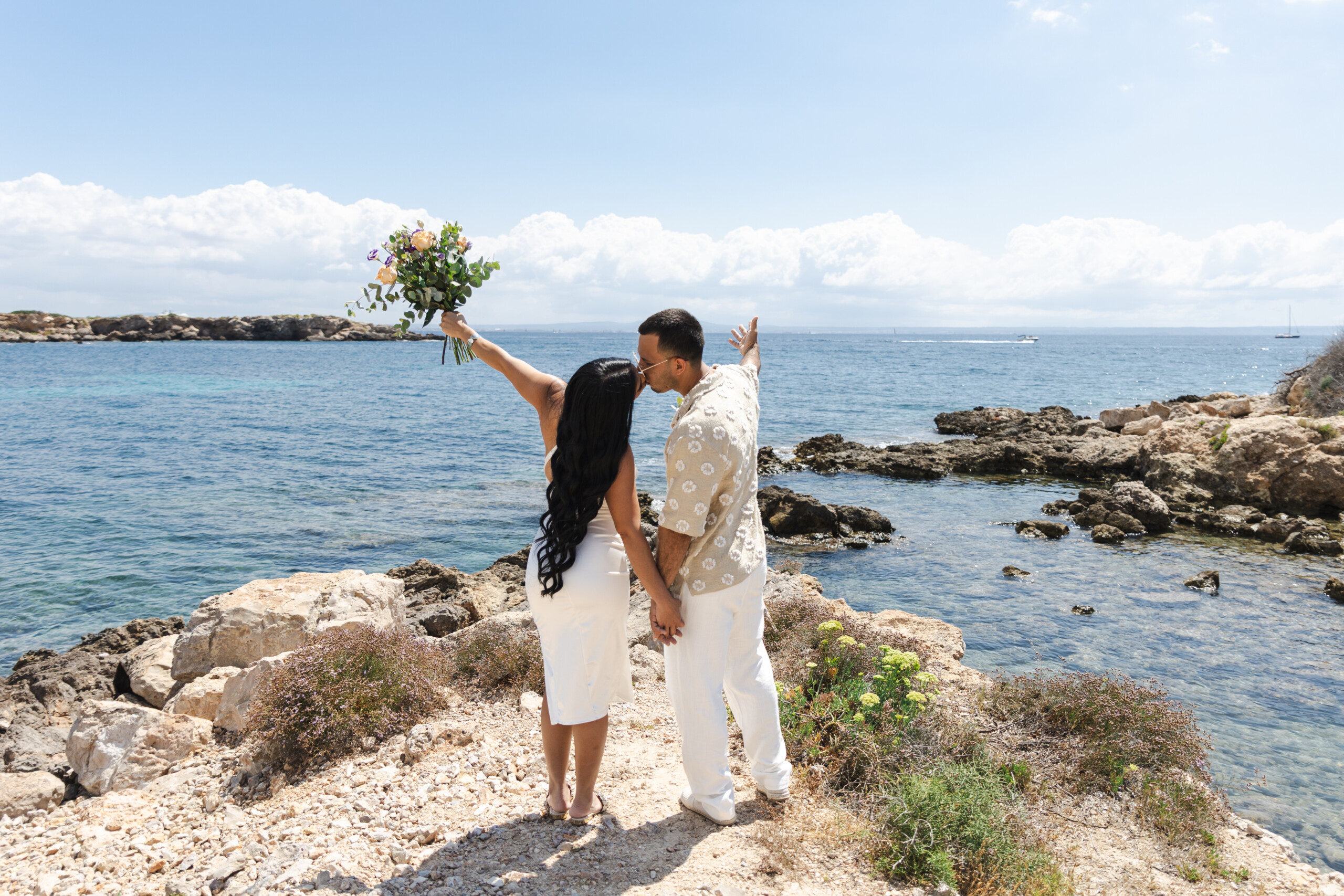
Proposal photoshoot by Danielle, Localgrapher in Mallorca
3. Sa Calobra and the Serpentine Road: Mallorca’s Most Photographed Switchback
The road down to Sa Calobra is the most spectacular drive in the Balearics, twelve hairpin switchbacks descending 800 meters through bare limestone cliffs to a tiny fishing cove at sea level. Shot from the right viewpoint, the entire road compresses into a single ribbon of asphalt curling down through the rocks. It ranks among the most rewarding Mallorca photo spots for any photographer willing to arrive before 8 AM.
Mirador de Sa Calobra at 7 AM, Not the Cove
Most visitors drive down to the cove, take a quick shot of the boats, and miss the actual photograph entirely. Drive about 500 meters back toward the Ma-10 to the small unmarked pull-off known locally as Mirador de Sa Calobra. From here you see all twelve curves of the serpentine road at once, with the sea visible at the bottom of the frame. Best between 7:00 and 8:30 AM, when the eastern sun rakes across the road and the cliff face is in soft light rather than blown-out white. Parking at the cove itself costs around $5 (around €5) for the day, but if you’re only shooting the road from above you can park on the verge for free. The cove itself is worth a separate shot: walk through the two short tunnels at the end of the beach and you’ll find the mouth of the Torrent de Pareis canyon, a dramatic limestone gorge where a seasonal river meets the sea. This works best at midday when the sun pierces straight down into the gorge.

4. Valldemossa: Stone Streets and Green Shutters
Valldemossa is the postcard mountain village of Mallorca, a cluster of honey-colored stone houses with deep green shutters and terracotta tiles, set against the dramatic backdrop of the Serra de Tramuntana. Chopin and George Sand wintered here in 1838 and the village has been a magnet for photographers ever since.
Carrer Rectoria Before 9 AM
The most photographed street in Valldemossa is Carrer Rectoria, the narrow cobbled lane below the parish church that climbs uphill between stone walls draped with bougainvillea and potted geraniums. By 10 AM, this lane is shoulder-to-shoulder with tour groups; before 9 AM, it is completely empty. Park at the public lot at the village entrance and walk five minutes uphill. Entry to the Royal Carthusian Monastery (Real Cartuja), where Chopin actually stayed, costs $12 (around €11) per person and is worth it for the cloister courtyards, but the village’s photogenic streets are all free. The best wide-angle frame is from the steps below the monastery looking back down at the rooftops with the mountains behind; the best portrait frame is on Carrer Rectoria itself, with the photographer positioned at the bottom of the lane and the subject roughly five meters up. Light is best between 8:30 and 10 AM, when the eastern sun fills the lane without yet hitting the upper walls and the bougainvillea catches a warm pink wash.

5. Deià and Sa Foradada: The Sunset Peninsula with a Hole in It
Deià is the artist village a short drive south of Valldemossa along the Ma-10, and just below it is one of the strangest geological features on the island: Sa Foradada, a 70-meter rocky peninsula with a large natural hole at the tip that lines up almost perfectly with the setting sun for a few weeks each year.
Mirador de Sa Foradada an Hour Before Sunset
The Mirador de Sa Foradada sits directly off the Ma-10 between Valldemossa and Deià, marked by a small pull-off and a stone wall. Arrive at least 75 minutes before sunset to get parking and pick your spot along the wall; by sunset itself, the viewpoint is packed five deep with phones. For a hike-in alternative, follow the dirt track from Son Marroig (the former estate of Archduke Ludwig Salvator, entry $5 (around €4)) down the peninsula to the rock itself, about 30 minutes one way, steep return, and you get the sunset framing the hole directly. Best months for the sun-through-the-hole alignment are roughly late May through July. Bring a wide-angle lens for the full peninsula composition and a long telephoto for compressed sun-and-hole shots. The Deià village above is also worth a separate visit for narrow stone lanes and the cemetery viewpoint, where Robert Graves is buried and where the light at 9 AM gives the rooftops a pale gold cast that doesn’t appear elsewhere on the island. Our photographers often pair Deià with Valldemossa as a single morning session before driving back west for a sunset on the peninsula itself.

“Sa Foradada at sunset is the kind of place where I never need to direct couples. The rock does the work, the sun does the rest, and I just frame it. The trick is the hike down to the peninsula itself, not the easy mirador shot. Most clients don’t want to do the 30 minutes down and the 45 minutes back up, but the ones who do come away with something almost nobody else has from Mallorca. The hole at golden hour from that lower angle is just impossible to repeat from the road.”
— Lina, Localgrapher photographer in Mallorca
6. Port de Sóller: The Vintage Tram and the Crescent Bay
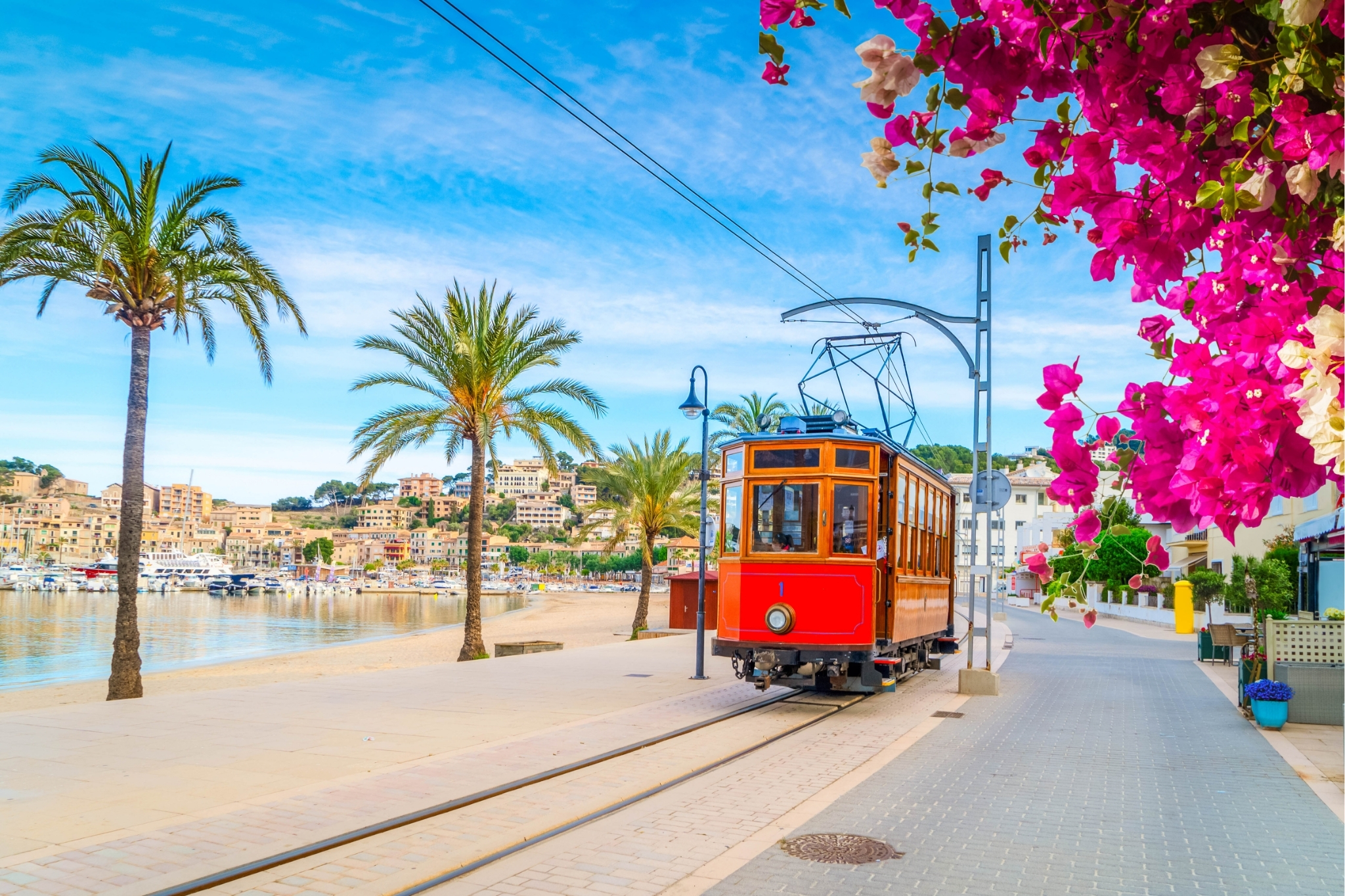
Port de Sóller is a horseshoe-shaped bay on the northwestern coast, connected to the inland town of Sóller by a 1912 wooden tram that still rattles down through the orange groves to the harbour. The combination of the tram, the bay, and the lighthouse on the western headland gives you three completely different photo opportunities within a 500-meter walk.
The Tram from the Eastern Promenade
Position yourself on the eastern promenade of Port de Sóller, facing west, around 10 AM. The vintage open-sided tram passes roughly every 30 minutes, and from this angle you get the tram in motion with the harbour and the western lighthouse behind it, a classic Mallorca shot that compresses three eras of the island’s history into a single frame. The tram costs about $9 (around €8) round-trip from Sóller to the port if you want to ride it for moving shots; just board at the inland Sóller terminal and shoot from inside through the open windows. For the lighthouse compositions, walk west along the bay to the trailhead at Far des Cap Gros, a 25-minute walk uphill, for the best wide angle of the bay at sunset. The water in Port de Sóller stays calm because the bay is almost fully enclosed by two headlands, so morning reflection shots of the surrounding mountains in the bay are exceptional, especially in September and October when the air is cooler and clearer than midsummer.
7. Es Trenc Beach: Mallorca’s Caribbean Stretch
Es Trenc is the longest undeveloped beach on the island, a two-kilometer stretch of soft white sand on the south coast backed by dunes and pine forest, with no hotels in sight. The shallow water turns a milky turquoise that looks more Caribbean than European, especially in the calm bays at either end of the stretch.
Ses Covetes Access at 7:30 AM, Sunset for Wide Shots
Es Trenc has three main access points. The northern access at Ses Covetes is the most photogenic and the quietest at sunrise. Park at the free roadside spots near the village and walk 100 meters down to the sand. At 7:30 AM in summer you’ll have the entire beach almost to yourself, the water is still glassy, and the low sun rakes sidelight across the dunes for textured composition. Avoid 11 AM to 4 PM completely: harsh overhead sun, beach club crowds, and the white sand bleaches out completely under direct light. For sunset, the southern access near the Es Trenc Hotel saltworks is better because you get the salt pans (Salinas d’Es Trenc) in the foreground with the beach behind; the pink-tinted water of the active salt ponds is a unique Mallorca Instagram backdrop that almost nobody knows about. Parking at the official Es Trenc lot is $8 (around €7) per day; the Ses Covetes free roadside verges fill up by 10 AM in season.

8. Caló des Moro: The Hidden Cove That Stopped Being Hidden
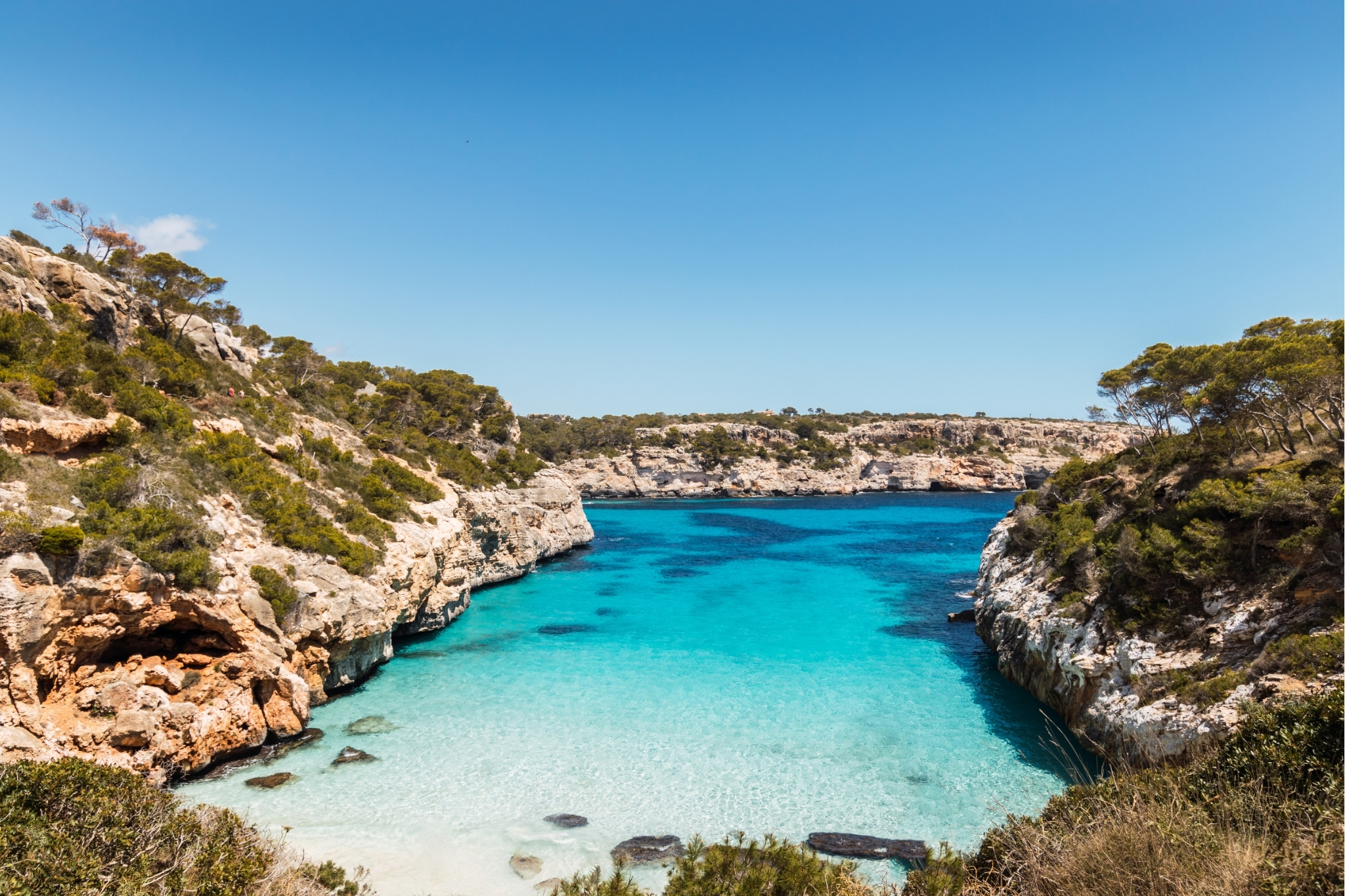
Caló des Moro is the small turquoise cove south of Santanyí that has become the single most-Instagrammed spot on Mallorca in the last five years. It is only about 30 meters wide, cradled between dramatic limestone cliffs, with water so clear you can see boats appearing to float in mid-air when shot from the cliff edge above.
Cliff Viewpoint at 7 AM, Not 11 AM
The reason Caló des Moro is on every Mallorca Instagram feed isn’t the beach itself but the cliff viewpoint on the eastern side, where you look down over the cove with the boats anchored below. To reach it, park in the village of Cala Llombards (parking is limited, arrive before 8 AM in season) and follow the dirt path along the cliff edge for about 10 minutes. By 11 AM in summer, the path is single-file traffic in both directions and the cove itself is wall-to-wall towels. At 7 AM, the path is empty, the cove is empty, and the rising sun lights up the cliffs from the east in warm gold, exactly the conditions you need for the shot. Don’t try the easier-looking path on the western side; it’s eroded and unsafe. Bring water shoes if you want to descend to the cove (the rocks are sharp) and a polarizing filter for the water; without one the turquoise gets washed out into a flat pale band that looks nothing like what your eye saw.
9. Castell de Bellver: Mallorca’s Circular Castle Above Palma
Castell de Bellver is a 14th-century circular hilltop castle west of Palma, one of only four round castles in Europe and the highest viewpoint over the city. From the upper terrace you see the entire bay of Palma, La Seu cathedral in the distance, and on clear days the mountains of Cabrera off the southern coast.
The Inner Courtyard at 10 AM, Bay View at Sunset
Castell de Bellver gives you two completely different photographs in one location. Enter at opening (10 AM, entry $5 (around €4)) and head straight to the inner circular courtyard, where the two-story gothic arcade gives you a clean symmetrical frame with strong shadows from the morning sun overhead, best between 10:30 and 11:30 AM, when the light angle paints half the wall and leaves the other half in shadow. Then walk up to the rooftop terrace for the city view, ideally returning at sunset (the castle stays open until around 7 PM in summer, 5 PM in winter, check current hours before you go). The view west from the rooftop catches La Seu cathedral lit by the setting sun and the bay turning peach. Our photographers often combine Bellver with the cathedral as a single half-day Palma session, with the morning at La Seu and the evening at Bellver bookending a lunch in the old town.

10. Es Pontàs: The Natural Stone Arch on the Southern Coast
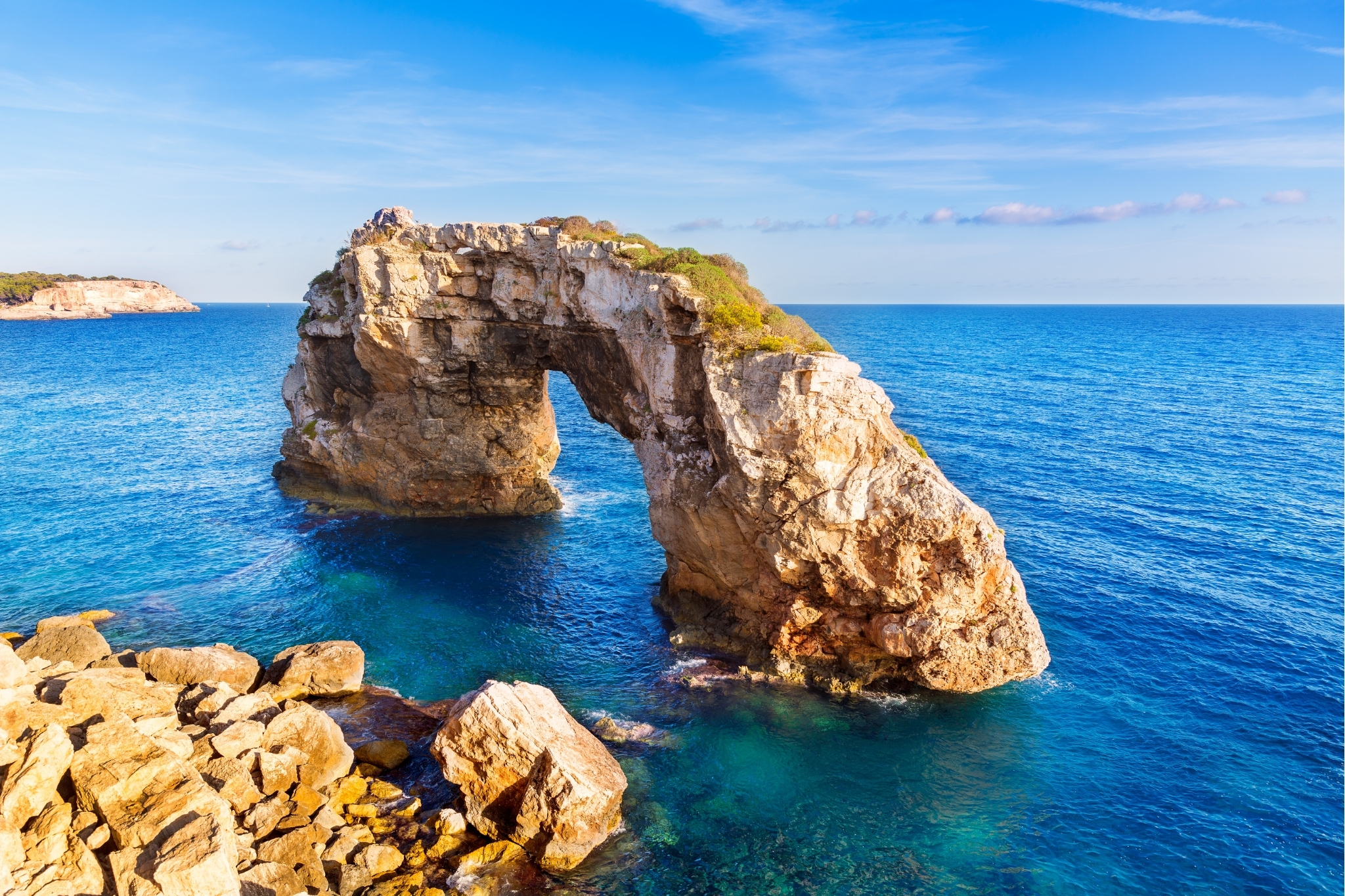
Es Pontàs is a massive natural limestone arch rising out of the sea just south of Santanyí, near the town of Cala Santanyí. The arch is roughly 25 meters tall and has become legendary among climbers and quietly known to photographers as one of the most dramatic coastal compositions on the island.
The Cliff Path South of Cala Santanyí at Sunrise
The arch is best photographed from the cliff path on the southern side of Cala Santanyí. Park at the public lot at the beach, then follow the marked coastal trail south for about 12 minutes until the arch comes into full view, rising out of deep blue water like a doorway built by the sea. Shoot at sunrise (around 6:45 AM in summer, 7:50 AM in winter) when the eastern light hits the arch from behind and turns the limestone amber; an hour later the sun is too high and the arch flattens against the water. The trail has a small gap in the wall where the foreground frame includes wildflowers in spring (April–May) and dry thyme in summer. There is no entry fee. The cliff edge is unfenced and the drop is significant, so don’t backpedal for a wider shot. For a sea-level perspective, kayak rentals at Cala Santanyí beach run about $35 (around €32) for two hours and let you paddle directly under the arch, a completely different photograph with the cliffs vertical above you.
“Es Pontàs is the place I take clients who want something nobody else has from Mallorca. The arch at first light is one of those frames where you just press the shutter and the photograph is already there. I had a couple last May who walked the cliff trail at six in the morning and we shot for an hour with not a single other person in view. By eight there were sixteen people on the cliff. The whole shoot is in those first ninety minutes, every time.”
— Danielle, Localgrapher photographer in Mallorca
Best Time of Day for Photos in Mallorca
Getting the timing right matters more at Mallorca photo spots than at almost anywhere else in the western Mediterranean, because the island packs four very different climates (coast, mountain, salt plain, and old city) into a 100-kilometer drive, and each rewards a different hour of the day.
Golden Hour and Season Specifics for Mallorca
Golden hour (morning): Sunrise in Mallorca runs from around 8:00 AM in late December to 6:25 AM in late June. The post-sunrise window for soft, low light lasts roughly 50 to 60 minutes. This is the best window for the coastal coves (Caló des Moro, Es Pontàs, Es Trenc), Palma’s Parc de la Mar reflection, and the lighthouse at Cap de Formentor.
Golden hour (evening): Sunset falls between roughly 5:15 PM (December) and 9:25 PM (June). Blue hour follows for 25 to 30 minutes after the sun drops. Sa Foradada, Port de Sóller, and Es Trenc’s salt pans are at their best in this window.
Worst light window: 12:00 PM to 4:00 PM between May and September. The Mediterranean sun is nearly overhead and creates flat, harsh shadows that blow out the white limestone and bleach the turquoise sea into a flat pale band on the horizon.
Season-specific notes:
- Shoulder (April to May, late September to October): the best overall light quality of the year, mild temperatures, low humidity, and most of the major spots free of summer crowds.
- Summer (June to August): long days and reliable sunshine but harsh midday light, packed beaches, and Formentor shuttle-bus restrictions; mornings before 9 AM are essential and afternoons are mostly a write-off.
- Winter (November to March): low golden sun all day long, dramatic Tramuntana storm clouds, no crowds at any major location; some cliff paths may close briefly after heavy rain.
- Early spring (February to March): almond blossom across the central plain around Bunyola and Santa Maria, a uniquely Mallorcan landscape subject that almost nobody photographs because the bloom window is only about three weeks.
- Late autumn (November): warm sea lingers, light is clear after summer haze, and the Tramuntana villages are empty on weekdays.
The hidden advantage of shoulder season (April to May, October) on Mallorca: the sea is still warm enough for water shots, the light is exceptionally soft because the air is drier than midsummer, and most of the coastal coves are empty. Our photographers often prefer these months for portrait work. For the full picture on outfits, group sizes, and what to expect on the day itself, our Mallorca photoshoot guide has everything you need before you book.
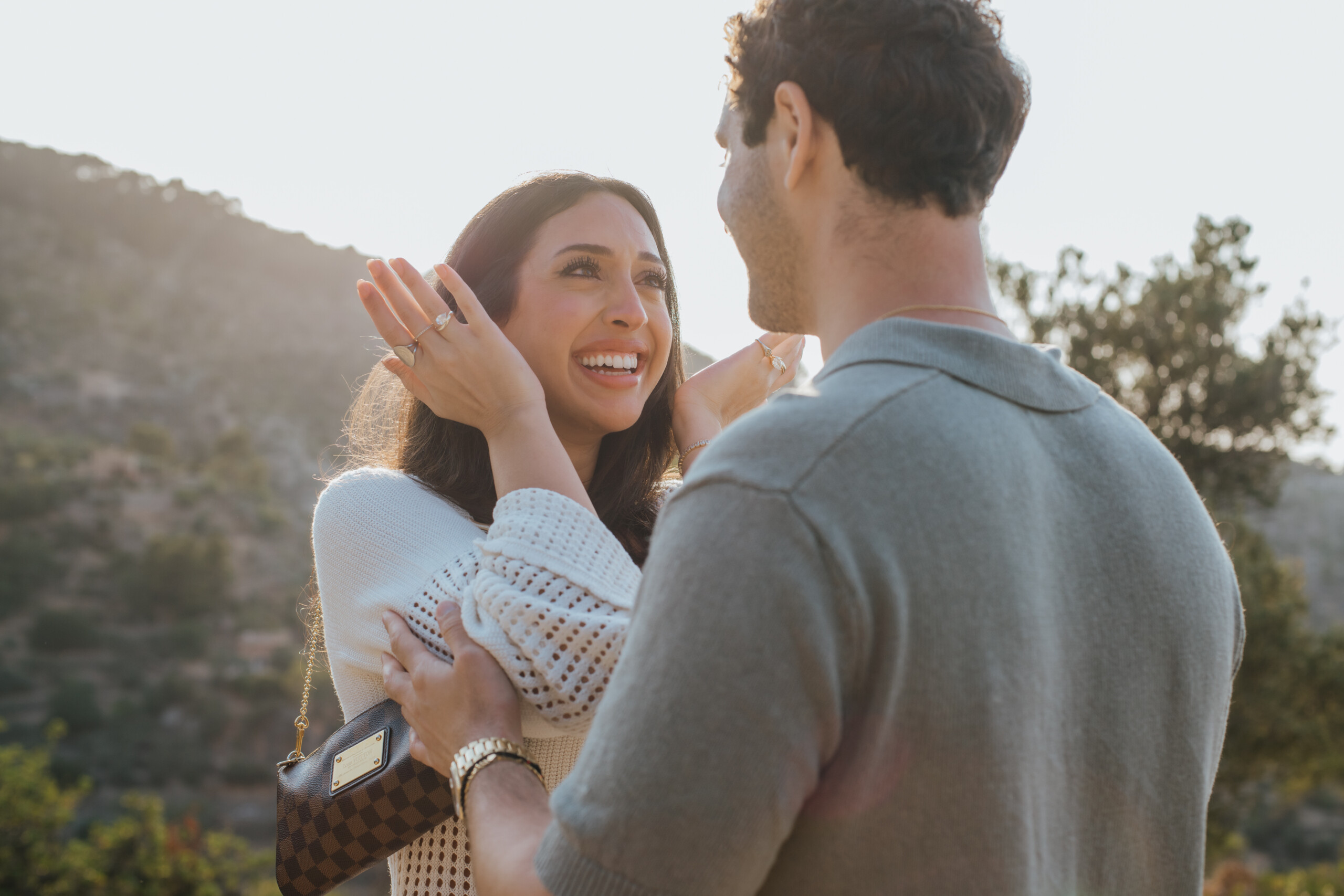
Proposal photoshoot by Laura C., Localgrapher in Mallorca
“The advice I give every client is the same: pick two locations, not five. The island looks small on the map but the roads through the Tramuntana are slow, and you’ll spend more time driving than shooting if you try to do Formentor and Es Trenc in the same day. A morning at La Seu and Bellver, or an afternoon between Valldemossa and Sa Foradada, those are the sessions that work. Two locations, an hour each, with the right light at both.”
— Laura, Localgrapher photographer in Mallorca
FAQ: Mallorca Photo Spots
Which Mallorca photo spots are best for a couples shoot?
Among all Mallorca photography locations, the ones that deliver the most consistent results for couples are Parc de la Mar at sunrise with La Seu cathedral reflected on the pool, the Mirador de Sa Foradada in Deià at sunset, the Carrer Rectoria cobbled lane in Valldemossa before 9 AM, the cliff viewpoint above Caló des Moro at first light, and the natural arch at Es Pontàs from the cliff trail south of Cala Santanyí. For something less-visited, the salt pans at Es Trenc and the inner courtyard of Castell de Bellver are quiet favorites among our local photographers and tend to give you photographs that look very different from the typical Mallorca beach feed.
Which Mallorca Instagram spots actually live up to the hype?
The single most over-promised Mallorca Instagram spot is Caló des Moro, which photographs spectacularly from the cliff viewpoint at 7 AM and disappointingly from the beach at 11 AM. The cove is real, but the path is short, the descent is steep, and the crowd window is narrow. The other heavily-photographed locations (Sa Calobra’s serpentine road, La Seu’s reflection in Parc de la Mar, the vintage tram in Port de Sóller) all live up to the photographs when you arrive at the right hour and have the right angle. The ones that consistently underperform their feeds are the inland windmills around Campos and the upscale beach clubs, which look better in stylized commercial shoots than they do in real ambient light.
How do I get between the best photo spots in Mallorca?
Most coastal and Palma-area spots are accessible by short taxi rides ($15 to $40, around €13 to €36). The Serra de Tramuntana villages (Valldemossa, Deià, Sóller, Sa Calobra) practically require a rental car or a hired driver because public transport into the mountains is limited and the roads are narrow and twisting. Cap de Formentor specifically has shuttle-only access between June and September from Port de Pollença. Our Mallorca photographers can meet you at any location and help plan the most efficient route between spots, especially if you want to combine a Tramuntana sunrise with a Palma sunset in the same day without spending the middle of it stuck in a queue at a hairpin.
Why hire a local photographer instead of shooting Mallorca yourself?
Because the difference between a good Mallorca photo and a great one is almost always timing and position, and that knowledge takes seasons of shooting the same locations to build properly. A local photographer knows that the Parc de la Mar pool is dead still at 6:45 AM and choppy by 8, that the Sa Foradada peninsula path takes a full 30 minutes one way, and that the cliff above Caló des Moro is already full by 9 AM in July. They also handle logistics: parking permits in Valldemossa, the Formentor shuttle schedule, which Tramuntana villages have road closures after heavy rain. Our photographers in Mallorca are vetted professionals who shoot here year-round.
Mallorca rewards photographers who plan ahead, wake up early, and pick their two locations carefully. The island’s best photography locations, from the gothic spires of La Seu over the still pool of Parc de la Mar to the cliff-edge arch at Es Pontàs and the empty turquoise of Caló des Moro at dawn, each have a specific window when the light, water, and crowd conditions align perfectly. With the right Mallorca photographer who knows those windows by heart, you stop chasing shots and start walking into them.
If you are still deciding where to take photos in Mallorca, whether for a couples shoot, a family session, or a solo portrait series along the Spanish Mediterranean, Mallorca photo spots deliver an extraordinary range of light and landscape within a 100-kilometer radius. Most of these locations are within 45 minutes of each other once you are on the right side of the Tramuntana ridge.