
The Western Promenade at 45 Minutes Before Sunset, Not Sunset Itself
Mykonos rewards photographers who understand its light. The island sits at 37.45 degrees north in the central Aegean, the summer sun is unforgiving by mid-morning, the whitewash on the Chora alleys turns chalk-flat from 10 AM to 6 PM, and the only reliable windows for the frames you came for are the 90 minutes after sunrise and the 90 minutes before sunset. Get the timing right and the reward is unique to the Cyclades: cobalt sea, lime-washed cubic houses, blue-domed chapels, and golden-hour shadow play across whitewashed steps no Mediterranean island further north can match.
The best Mykonos photo spots sit inside a compact triangle. Chora, the windmills above Alefkandra, and the south-coast beaches are within a short walk or scooter ride, and the few exceptions (Armenistis, Fokos, the Delos day trip) reward an early start with the cleanest light of the day. This guide was written with input from Magdalene, Alessa, Dionysis, Spyros, Valentina, Alexandra, Apostolos, and Kevin, our Mykonos photographers who shoot these locations week after week. It is an honest insider map of where the light lands, when the crowds disappear, and what TripAdvisor will not tell you.
1. Little Venice (Mikri Venetia): The Sunset Frame Everybody Wants
Little Venice is the strip of 18th-century captains’ houses that drop straight into the sea at the western edge of Chora, balconies hanging directly above the water. At the right hour, the warm cream and ochre rendering lights up against the deep blue of the Aegean, and a slow swell breaks against the wall ten metres below. The frame is unmistakably Mykonian and works for couples, solo travellers, and editorial portrait sessions equally well.
The catch is timing. Between noon and 5 PM the houses fall into deep shadow, and by 6 PM the seafront bars on the Alefkandra strip pack two-deep along the promenade.
We send couples to the Alefkandra promenade 45 minutes before the official sunset, which in June is around 8:00 PM and in October around 6:00 PM. That window gives you 20 minutes of warm raking side-light directly on the wall of houses before the crowds arrive, then another 25 minutes of soft afterglow once the sun drops. Position the subject on the low seawall outside Galleraki bar, 20 metres south of the Caprice cocktail terrace, facing the balconies. The compression at 50mm pulls the houses into a clean stack of warm pastels with the subject silhouetted against the lit wall. If the meltemi is up, the swell against the wall makes for a dramatic backdrop, but bring a towel for the spray.

“Little Venice in late September around quarter past seven is the cleanest hour I shoot all year. The summer crowds have thinned out, the light comes in flat across the wall, and we get fifteen minutes where the houses look like they are lit from inside.”
— Alessa, Localgrapher photographer in Mykonos
2. Kato Mili: The Five Windmills Above the Bay
The row of five whitewashed Venetian windmills on the low ridge above Alefkandra is the second canonical Mykonos silhouette. Built in the 16th century to grind wheat for the fleet, they look across the bay toward Little Venice and into the open Aegean beyond. The compositional gift is the alignment: five identical white drums lined up against the horizon, sea filling the lower third, Tinos visible on a clear day in the distance.
Most visitors shoot from the asphalt road that runs along the back of the windmills, which puts tarmac and a tour bus into every frame. The real spot is the dirt path that traces the seaward slope below.
The Seaward Slope, Not the Tarmac Road
Drop off the tarmac onto the dirt path that runs along the seaward side of the ridge, position yourself ten metres below the line of mills, and shoot upward with a 35mm. The windmills stack across the frame and the cobalt sea fills the lower third. Sunset is popular here, so we usually shoot at sunrise instead: around 6:30 AM in summer and 7:30 AM in winter, when the path is empty, the windmills catch the first light from the east, and the bay below glows orange. Bring grip; the slope is steep in places. For a tighter, more graphic frame, isolate two mills at 85mm with the sky as negative space.

3. Paraportiani Church: The Whitewashed Sculpture
Paraportiani, on the western edge of Chora just below the entrance to Kastro, is technically five chapels fused together into a single irregular whitewashed mass over four centuries of organic building and rebuilding. The result is something between architecture and sculpture, all curves, domes, and shadow pockets, with no two angles giving the same shape. It is one of the most distinctive Mykonos photography locations and was famously documented by Henri Cartier-Bresson in 1953.
The frame moves with the sun. At sunrise, the eastern face catches a warm raking light that throws the domes and barrel vaults into sharp relief. By midday the church goes flat. From around 5 PM onward in summer, the western face lights up and a deep blue Aegean sits behind it as a clean backdrop.
The Western Approach at 6:30 PM in Summer, 4:30 PM in Winter
Walk down from Kastro and approach Paraportiani from the western (seaward) side. Position yourself ten metres back, frame the building against the sea, and shoot at 24 to 35mm to include the irregular roofline against an empty horizon. The white render reads brilliantly against the cobalt sea, the shadow pockets give the surface dimension, and at 6:30 PM in summer there is a 25-minute window when the light skims directly across the western face. Avoid the noon to 4 PM window in summer entirely; the high overhead light flattens the sculptural quality and bleaches the whitewash into a featureless white blob.

4. Matoyianni Street and the Chora Alleys: Bougainvillea and Whitewash
Matoyianni is the main pedestrian artery of Chora and the spine of a network of narrow whitewashed alleys that fan out from it. The frame is textural rather than architectural: lime-washed walls, cobalt and aquamarine shutters, magenta bougainvillea spilling across stone arches, and the occasional church bell tower closing a sightline. The lanes were intentionally laid out as a labyrinth to confuse pirates centuries ago, and that maze quality is what makes them so productive today, and exactly where to take photos in Mykonos if you want a frame that does not need editing.
The dominant problem is foot traffic. By 11 AM the alleys are crowded with cruise-ship day-trippers, which kills almost every frame. We schedule sessions here at 7 to 9 AM, when shops are still shuttered and the light is at a clean angle for the cobalt shutters.
7 AM on the Enoplon Dynameon and Mitropoleos Lanes
Skip Matoyianni itself, which is wider and less photogenic, and head one block north to Enoplon Dynameon and Mitropoleos lanes. These run roughly east to west, which means at 7 AM the rising sun shoots directly down them and turns the whitewashed walls into glowing corridors. The bougainvillea arch on the western end of Mitropoleos, just before it meets the Panachra church courtyard, is the canonical Instagram spots Mykonos frame. Bring a 35mm for the corridor compression. The cobalt shutters on the houses near the small Tria Pigadia square give you a different palette twenty metres further north. Wear flat-soled shoes; the cobbles are slick after night rain.

5. Armenistis Lighthouse: The Clifftop With Tinos in the Distance
The 19-metre Armenistis Lighthouse sits on a low headland at the northwestern tip of the island, 25 minutes by car from Chora and almost completely overlooked by the day-trip crowd. The frame is pure: a single stone-and-iron lighthouse on a basalt clifftop, an empty grass meadow leading to the cliff edge, and Tinos rising 12 kilometres across the sea channel to the west. On a clear evening the light bends warm across the meadow and the lighthouse silhouette stretches a hundred metres east in shadow.
There is no entry fee, no gate, and very rarely anybody else there. The road ends at a small parking area and a five-minute walk takes you to the lighthouse itself.
45 Minutes Before Sunset, From the Northern Cliff Edge
Park at the lot and walk past the lighthouse to the northern cliff edge, 60 metres beyond the structure. From there, frame the lighthouse against the sea with Tinos in the upper-right corner. The meadow grass turns gold an hour before sunset, the lighthouse rim catches the last warm light, and you get 30 minutes of usable frames before the sun drops behind the western horizon. The meltemi blows hard across this headland in July and August, so layer a windbreaker even in summer. For a tighter composition, walk 100 metres east of the lighthouse and use the stone wall remnants there as a foreground anchor. This is one of the few photo spots where you can shoot for an hour without seeing another tourist.
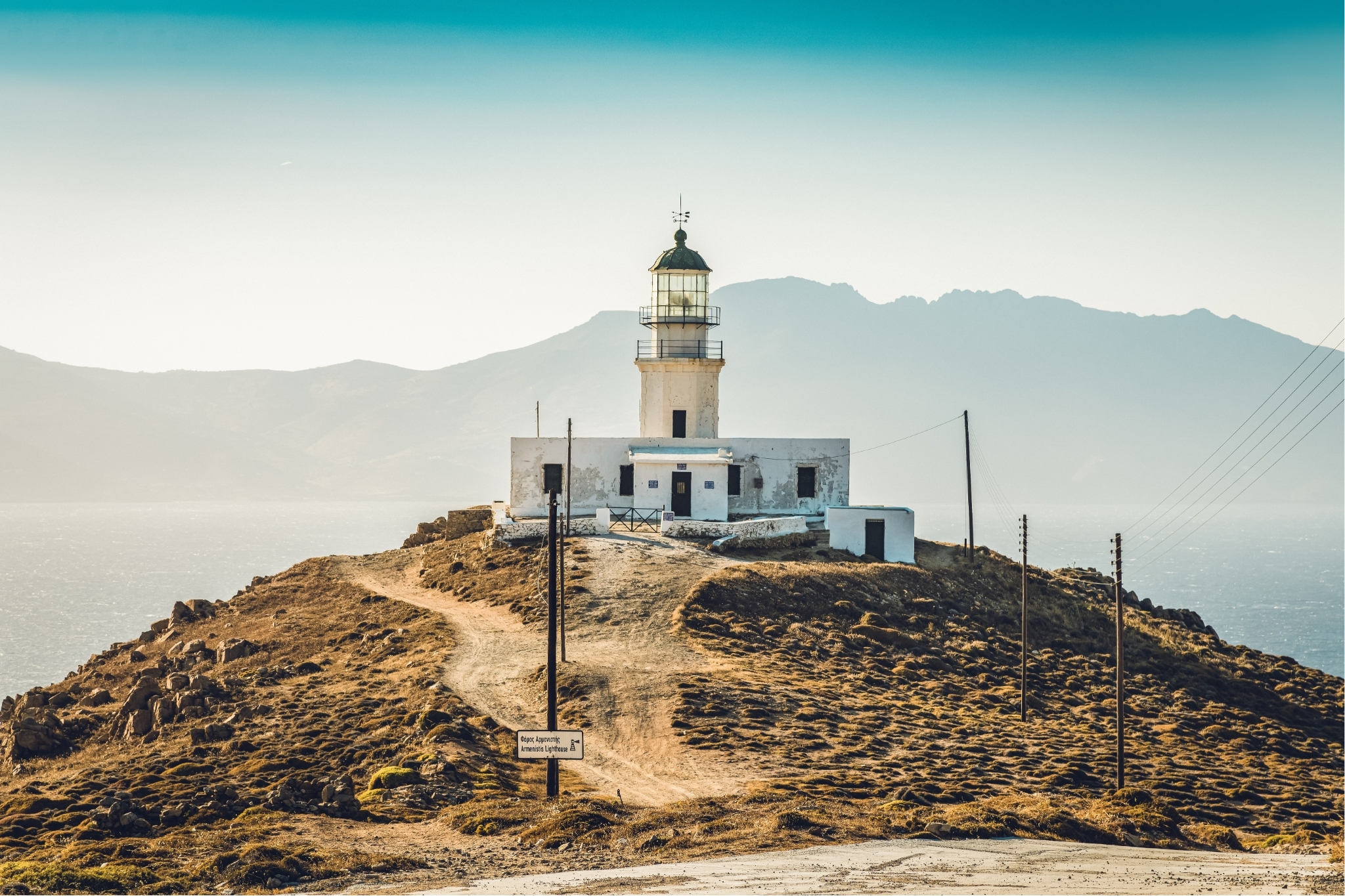
“Armenistis at sunset is where I take everyone who tells me they have already photographed Little Venice. The headland is wild, the lighthouse silhouette against the Tinos channel is a frame nobody else has, and the wind on the cliff edge gives the whole session a kind of cinematic energy.”
— Spyros, Localgrapher photographer in Mykonos
6. Agios Ioannis Beach: The Shirley Valentine Frame
Agios Ioannis is a small south-coast beach 15 minutes by car from Chora, made famous in 1989 by the film Shirley Valentine and still one of the best places to photograph Mykonos with a view of the sacred island of Delos directly across the channel. The beach is split into two coves by a small headland: the northern cove holds the Hippie Fish taverna, the southern cove is quieter, with the white-domed chapel of Agios Ioannis sitting just back from the sand.
The composition is generous. A foreground arc of golden sand, turquoise shallows pulling out to the cobalt channel, the silhouette of Delos in the middle distance, and the white-and-blue chapel anchoring the upper edge of the frame.
The Southern Cove at 7:30 AM, Before the Tavernas Open
Park at the Hippie Fish lot and walk south through the headland gap to the quieter cove. At 7:30 AM in summer (8:30 AM in winter), the sun comes up over the headland to the east and lights the chapel and the sand from the side. Position the subject on the firm sand strip 5 metres back from the water and frame Delos in the upper third. The chapel makes a strong secondary anchor 30 metres to the north. The taverna opens at noon, so anything before 11 AM gives you the beach completely empty. Bring waterproof footwear if the meltemi is up; the swell at this cove gets rough by 10 AM in July and August.

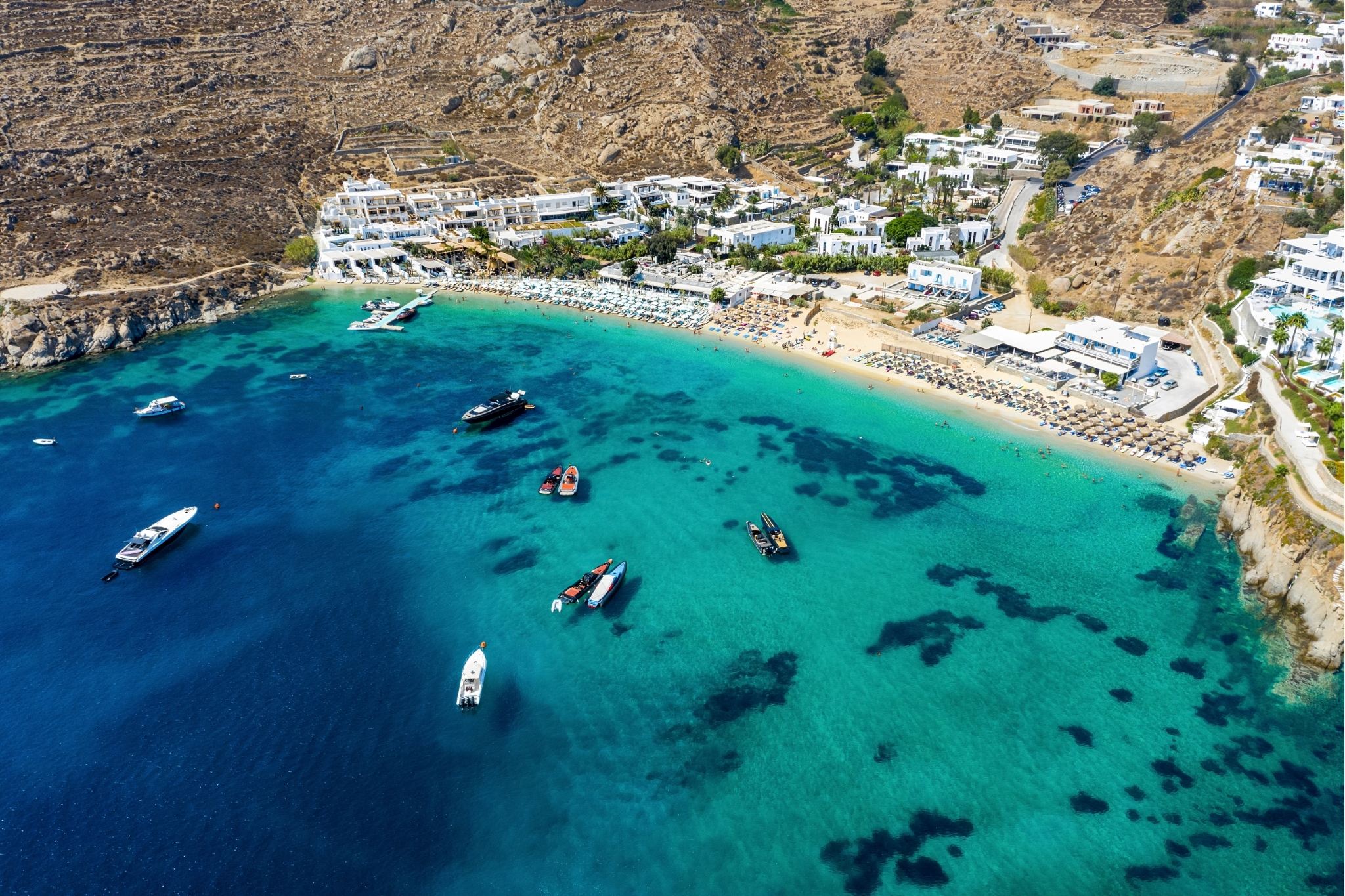
7. Psarou Beach: The Polished South-Coast Cove
Psarou is the small protected south-coast cove that has become Mykonos’s most polished beach, with the Nammos beach club running the southern arc and a row of upscale tavernas along the rest. The water is clarity-glass, the protected bay shape gives you long stretches of mirror-calm sea even when the meltemi is shaking the open coast, and the sandy crescent reads bright against the headland walls on either side.
The frame is not the beach club furniture (which fills out by 11 AM and reads as commercial clutter) but the wider bay shape and the clarity of the water. Sessions here work best at sunrise, when the loungers have not yet been raked out and the sea is glass-flat.
The Eastern Headland at 7 AM
Walk to the eastern headland (the Mykonos Blu side) and position the subject on the rock shelf that drops into the water 8 metres above the sea. The arc of the bay opens out below, the Nammos terraces sit empty on the far side, and the water clarity at this hour shows every stone on the seabed 4 metres below. Shoot at 35mm for the whole cove or 85mm to compress the subject against the sea texture. By 9 AM the first beach club staff start setting up, so the empty-bay frame has a roughly two-hour window from sunrise. Bring water shoes if you plan to step into the shallows.
8. Fokos Beach: The Wild North Coast
Fokos is the antidote to the polished south coast: a remote beach on the northeastern shore reached by a 4-kilometre dirt road from Ano Mera, with no beach clubs, no umbrellas, no music, and only a single rustic taverna at the back of the cove. The frame is wild Cyclades, raw and unmanicured, with a long arc of dark gold sand, an open bay opening into the Aegean, and weathered grey-green hills rising behind the beach.
This is the spot for sessions that need air. No built structure in the wider frame, no other people, and the contrast between textured sand, deep blue water, and muted hill colour gives portraits a documentary quality the more commercial beaches cannot.
The Northern End of the Beach at 4 PM
Park at the taverna lot and walk to the northern end of the cove, 200 metres from the parking area. The afternoon sun arrives from the southwest and rakes across the beach face, throwing long shadows from the dune line and driftwood along the high-tide mark. Position the subject 30 metres back from the waterline so the dune ridge is in the upper third and the bay arc fills the rest of the frame. Sunrise here is exceptional but the sun rises over open sea, so the light hits the back of the cliffs rather than the beach, which works for moody silhouette frames but not clean portraiture. Bring water and shade; there is no beach service south of the taverna.

9. Ano Mera and Panagia Tourliani Monastery: The Inland Village
Most visitors never leave the coast, but Ano Mera, the only other settlement on the island, sits 8 kilometres east of Chora and gives you an entirely different palette: a quiet village square shaded by plane trees, family tavernas with no cruise-ship traffic, and the 16th-century Panagia Tourliani Monastery, whose ornate marble bell tower and red-tiled domes break the all-white Mykonian rule and read warmly against the surrounding hills.
The monastery courtyard is open daily 9 AM to 1 PM and again from 3 PM to 7 PM. The interior holds a richly decorated wood-carved altar screen from 1775 and is worth a quiet walk-through. Entry is free, but shoulders and knees should be covered.
The Bell Tower From the Square at 5:30 PM in Summer
Stand on the western edge of the village square, 25 metres back from the monastery entrance, and frame the bell tower against the late-afternoon sky. The marble carvings on the tower catch the warm 5:30 PM light and the red-tiled domes anchor the lower edge of the frame. Inside the courtyard, the cypress trees against the white walls give you a quieter, more contemplative portrait setting. Combine Ano Mera with the Fokos run for an afternoon route: monastery at 5 PM, Fokos by 6 PM, and back to Chora for blue hour at Little Venice if you have the energy. Avoid Sunday morning service hours for a session inside the courtyard.

10. Delos: The Archaeological Day Trip Worth Every Hour
Delos is a separate island, 30 minutes by ferry from Mykonos Old Port, and one of the most important archaeological sites in the eastern Mediterranean: birthplace of Apollo in myth, and a UNESCO World Heritage site since 1990. The site is open April 1 through November 30 only. Daily ferries from Mykonos run from roughly 9 AM, the last return is usually 3 PM, and a round-trip ticket costs around $27 (around €25). Site entry is an additional $22 (around €20).
The site is enormous, low, and almost entirely without shade. The frame here is unlike anywhere else: marble columns of the Stoivadeion, the famous Terrace of the Lions (replicas; originals are in the Delos museum), and the long rows of ancient stone walls running down to the sea, with Mount Kynthos rising above the site.
Terrace of the Lions at 10:30 AM on the First Ferry
Take the first ferry of the morning (8:30 to 9:00 AM departure from Mykonos Old Port, check the timetable the night before) and head straight to the Terrace of the Lions on arrival. The five reconstructed lions face east and the morning light catches their flanks at 10:30 AM beautifully, with the empty Sacred Way running south behind them. Move on to Mount Kynthos for the panorama (a 15-minute climb) and the House of the Dolphins for the mosaic detail. The site closes at 8 PM in summer, but the last return ferry leaves around 3 PM, so plan for a four-hour visit. Bring water, a hat, and proper shoes; the surface is uneven marble and broken stone throughout. The meltemi can disrupt the ferry crossing in July and August, so check the forecast the evening before.
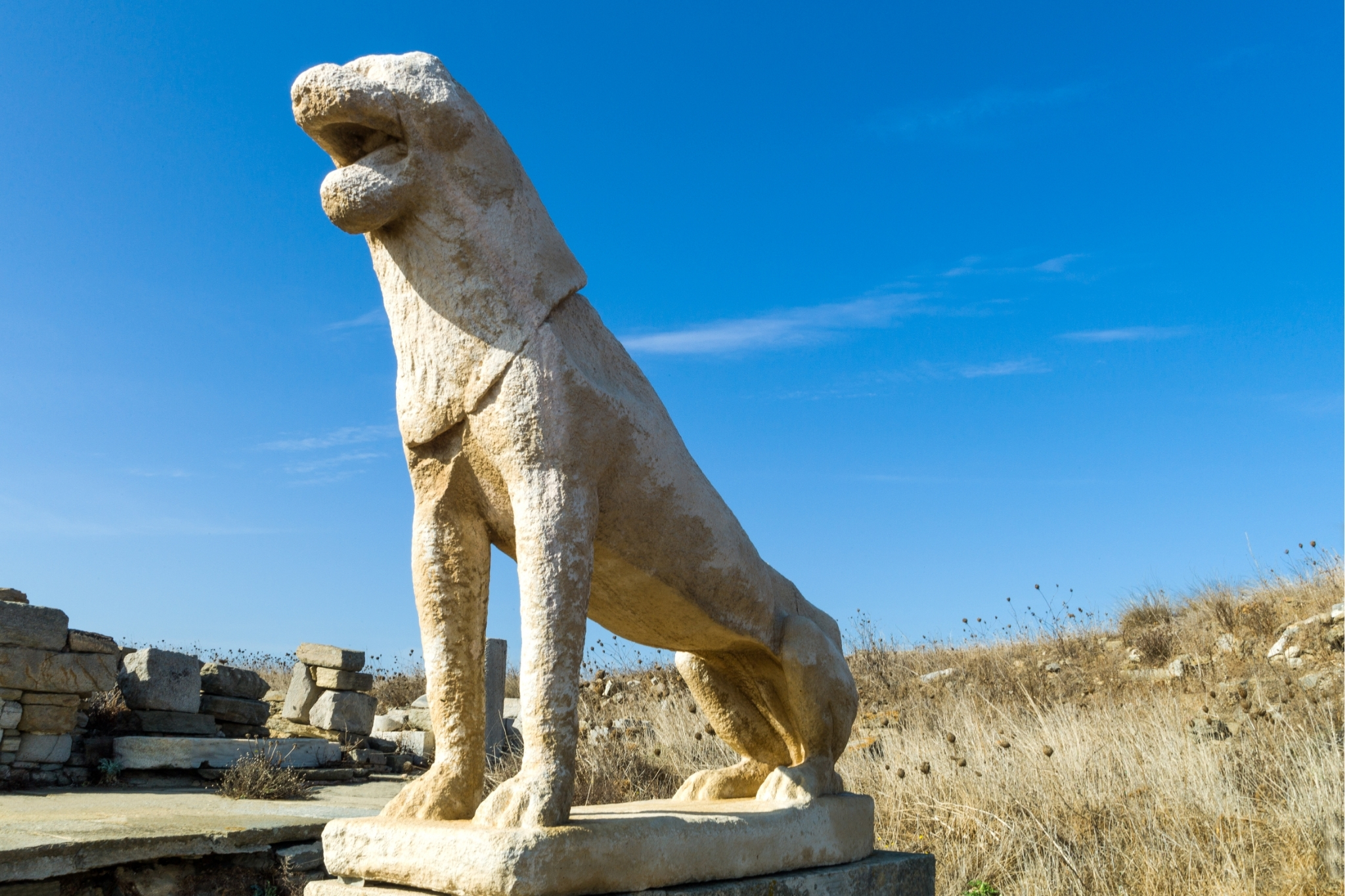
“Delos at 11 AM with the Sacred Way empty and the Lions catching that low morning light is the most special frame in the Cyclades, in my opinion. I bring a 70-200 and shoot the columns from the eastern footpath where the Stoivadeion stacks behind them. The sense of scale you get from those frames is something no Mykonos street can match.”
— Magdalene, Localgrapher photographer in Mykonos
Best Time of Year for Mykonos Photo Spots
Getting the timing right matters more at Mykonos photo spots than almost anywhere else in the Aegean, because the light at 37.45 degrees north behaves very differently in summer (high, harsh, overhead from 10 AM to 6 PM) and in spring or autumn (lower, longer, and softer). The photographic year divides cleanly into four windows, and our team plans bookings around them.
Light by Season at This Latitude
- May to early June: The opening window. Daytime 22 to 26 degrees Celsius, wildflowers still in bloom on the headlands, and the meltemi has not yet arrived. Sunrise around 6:15 AM, sunset around 8:30 PM, blue hour holds 25 to 30 minutes. The most balanced light of the year, and the lowest crowd density.
- July to August: Peak crowds, peak heat (28 to 32 degrees Celsius), and the strongest meltemi winds of the year, gusting from the north-northwest at 30 to 50 km/h. The midday window from 10 AM to 6 PM is unworkable for portrait photography, but the 6 AM and 7:30 PM windows are spectacular. Book strictly at dawn or in the last hour before sunset. The Delos ferry can be cancelled at short notice on high-wind days.
- September to mid-October: The closing window and our team’s favourite. Daytime 24 to 28 degrees Celsius, sea still in the mid-20s, meltemi tapering off after the first week of September, and cruise-ship volume drops dramatically after Labour Day. The light angle softens steadily through October.
- November to April: The off-season. Many tavernas and the Delos ferry close. Daytime 12 to 18 degrees Celsius, occasional rain, but the Chora alleys are completely empty and the light is the softest of the year. For editorial or moody work, this is an underused window.
- Our recommendation: Mid-September to mid-October is the ideal window for most couples and families. The crowds have cleared, the sea is still warm, the meltemi has settled, and the light is at its softest for the year.

Proposal photoshoot by Apostolos, Localgrapher in Mykonos
“September is the month I tell every visiting couple to aim for. The light is honestly twice as good as July, the alleys in Chora are empty by 8 AM, and the sea is still bathwater warm. I shoot more weddings and proposals in the second half of September than in any other six weeks of the year.”
— Valentina, Localgrapher photographer in Mykonos
Practical Notes for Photographing Mykonos
A few logistical points apply across most of the Mykonos photography locations our team works with, and getting them right saves an entire morning of frustration.
- Meltemi winds: the north-northwest summer wind is not a problem, it is a creative tool. Hair, fabric, sea spray, and bougainvillea petals all become motion elements. Check the forecast the evening before.
- Footwear: the Chora alleys are paved with smooth marble inlays that turn slick after night dew. Stick to flat soles with grip; the windmill ridge and the Armenistis headland both have loose gravel sections.
- Transport: Chora, the windmills, Little Venice, Paraportiani, and Matoyianni are walkable. Armenistis, Fokos, Ano Mera, Psarou, and Agios Ioannis need a scooter, ATV, or taxi. Local buses are slow in peak season.
- Permits: no permit is required for personal or small private photography sessions. Commercial shoots at the Delos archaeological site require advance permission from the Ephorate of Antiquities.
- Light hours: download a sun-position app before you arrive. The difference between 6 AM and 7 AM in summer is enormous, and a missed window cannot be recovered.
FAQ: Mykonos Photo Spots
What are the best photo spots in Mykonos?
Among all Mykonos photography locations, the ones that deliver the most consistent professional results are Little Venice at 45 minutes before sunset, Kato Mili at sunrise, Paraportiani Church on the western approach at 6:30 PM, the Chora alleys around Enoplon Dynameon at 7 AM, and Armenistis Lighthouse at sunset. For something less-visited, Fokos Beach on the north coast and Panagia Tourliani Monastery in Ano Mera are favourites among our local photographers.
What time of day is best for photographing Mykonos?
The two productive windows are roughly 6 AM to 9 AM and 6 PM to 9 PM in summer, shifting to 7:30 AM to 10:30 AM and 4 PM to 6 PM in winter. The whitewashed walls need a low side-light to read texture, and overhead midday light bleaches the lime-wash into a featureless flat plane. The 30 minutes after sunset, when the houses still hold residual warmth against a darkening blue sky, is the secondary window for Little Venice and the windmills.
How do I avoid crowds at the most popular Mykonos photo spots?
Arrive before 9 AM. The Chora alleys, Little Venice, and Paraportiani all fill up by 11 AM in summer because of daily cruise-ship arrivals. Local photographers schedule sessions at 6:30 to 8:30 AM specifically to lock in empty-alley frames. For sunset spots, arrive at least 45 minutes before sunset to claim a clean angle on the Alefkandra promenade.
Where can I get the classic Mykonos windmill photo?
Two angles cover the canonical windmill shot. The seaward dirt path below the Kato Mili ridge for the full row of five mills with the bay in the foreground, and the Alefkandra promenade looking back up at the ridge from below, where the mills form a silhouette against the western sky at sunset. The Kato Mili angle works best at sunrise and the Alefkandra angle at sunset.
Why is Mykonos light harsher than other Mediterranean islands?
Latitude and reflectivity. Mykonos sits at 37.45 degrees north, well south of the Italian Riviera, and the all-white architecture acts as a giant reflector that doubles the perceived intensity of the midday sun. The result is that golden hour windows are narrower and harsh-light bleaching is more aggressive than further north. For the full picture on outfits, timing, and what to expect on the day itself, our Mykonos photoshoot guide has everything you need before you book.
Mykonos rewards photographers who plan ahead and respect the light. Every location, from Little Venice at last light to the windmill silhouettes against the Aegean and the empty Sacred Way on Delos, has a narrow window when timing and crowd conditions align. The all-white architecture punishes lazy timing, and the difference between a great frame and a flat one is almost always 90 minutes either side of the sun.
Every spot above comes from frames our local photographers shoot week after week, with angles tested in meltemi gusts, glassy mornings, dawn, and dusk, and refined over years of running sessions across the island. The locations are the easy part; what turns them into great photographs is timing, position, and the photographer who knows the difference. With the right hour and the right vantage, you stop chasing shots and start walking into them.