
Planning a Jaipur photoshoot? The best time to shoot is October through February, when the desert air clears, temperatures drop to something comfortable, and the Pink City’s sandstone facades glow amber in the morning light. Start your day at 6:30–7:00 AM at Hawa Mahal or the Amer Fort approach for soft, unobstructed golden light before the tour coaches arrive. Top spots include the Amer Fort, Patrika Gate, and the rose-washed corridors of the City Palace. Our photographers start at $280 (₹23,300) for a 30-minute session with 20 edited photos delivered within four business days.
Best Time of Year for a Jaipur Photoshoot
Jaipur sits in the Thar Desert at 27°N, which means its seasons are defined not by rain and cloud like a coastal city, but by heat, dust, and the dramatic arc of desert light. The difference between a crisp January morning at Amer Fort and a June afternoon at the same spot is the difference between magic and misery — for photographer and client alike. Here is how the calendar breaks down.
Year breakdown
Jan–Feb
Weather: Cool and dry (8–22°C / 46–72°F), occasional morning fog in January
Light quality: Crystal-clear afternoons, warm morning tones; fog adds drama in early January
Our recommendation: ★★★★★ Peak season — the finest conditions of the year
Mar–Apr
Weather: Warming quickly (20–35°C / 68–95°F), dry and increasingly hazy
Light quality: Strong golden hour windows; midday becomes harsh by mid-March
Our recommendation: ★★★★☆ Good if you commit to early mornings
May–Jun
Weather: Intense heat (32–45°C / 90–113°F), hot winds (loo), dust
Light quality: Bleached and harsh; beautiful only in the 30 minutes post-sunset
Our recommendation: ★★☆☆☆ Extremely challenging; heat affects clients and equipment
Jul–Aug
Weather: Monsoon season (25–35°C / 77–95°F), heavy but intermittent rain
Light quality: Dramatic stormy skies; post-rain light on the pink sandstone is extraordinary
Our recommendation: ★★★☆☆ Rewarding for the adventurous; requires flexibility
Sep–Oct
Weather: Transitional, cooling fast (22–33°C / 72–91°F), clear skies returning
Light quality: October delivers the first truly golden-toned days after monsoon dust settles
Our recommendation: ★★★★☆ Underrated; increasingly popular as word spreads
Nov–Dec
Weather: Crisp and cool (10–25°C / 50–77°F), dry, excellent visibility
Light quality: Low sun angle, warm and directional; fort walls and palace facades look spectacular
Our recommendation: ★★★★★ Peak season — book well in advance

November through February is when Jaipur rewards photographers most consistently. The desert sky loses its haze, the sandstone of Amer Fort and Nahargarh glows a deep honey-gold in the hour after sunrise, and temperatures are comfortable enough to sustain longer sessions — a genuine issue in a city where summer heat can hit 45°C. One date worth noting for advance planning: Diwali (typically October or November) transforms Jaipur into one of the most visually extraordinary cities in Asia, with the forts illuminated and the old city lit with oil lamps and marigolds. If your trip overlaps with Diwali, build your session around it.
Best Time of Day: Golden Hour, Harsh Light, and When to Stay Inside
Jaipur’s latitude means the sun is high and intense for much of the year. The workable photography window is narrower than in European cities, but within that window — particularly at the forts and gardens — the light is among the most cinematic you’ll find anywhere in South Asia. Knowing exactly when to be where makes or breaks the session.
Morning Golden Hour
6:30–8:00 AM (year-round, shifting slightly by season). This is the window that defines a Jaipur photoshoot. The Amer Fort approach road — the long ramp leading up to the Suraj Pol gate — catches the first horizontal rays of desert sun and turns deep terracotta. By 7:15 AM, the fort’s mirrored Sheesh Mahal courtyard is lit by angled light that bounces off hundreds of inlaid mirrors and creates a shimmer impossible to reproduce at any other hour. At street level in the old city, the chai vendors and flower sellers setting up at the base of Hawa Mahal create a living, layered backdrop that disappears by 9:00 AM.
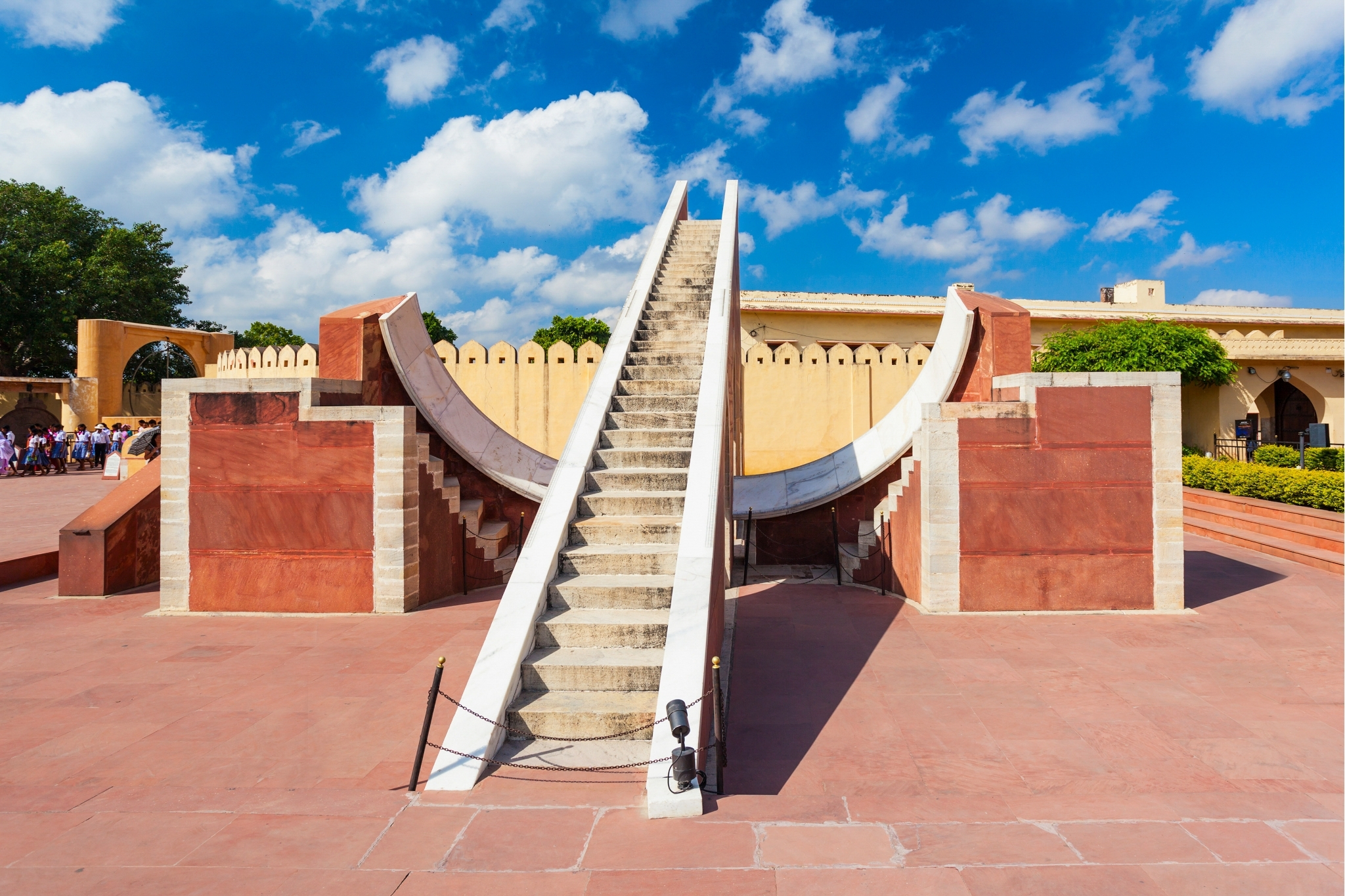
“Jaipur’s morning is like nowhere else I’ve photographed. The fort at 6:45 AM — the light on the sandstone, the empty courtyard, the silence before the tour buses arrive — that window is everything. I plan every session around it.”
— Anshul, Localgrapher in Jaipur
Harsh Light Window to Avoid
9:30 AM–4:00 PM (May–September: 9:00 AM–4:30 PM). Jaipur’s desert latitude amplifies midday harshness far beyond what photographers encounter in coastal Indian cities. The pale sandstone and white marble of sites like Birla Mandir become blinding reflectors, and the flat overhead light eliminates every shadow that gives the forts their three-dimensional depth. Our photographers do not schedule outdoor portrait sessions in this window from April through September. Indoor alternatives — the interior galleries of City Palace, the shaded corridors of Jantar Mantar — are workable in this window if the session requires it.
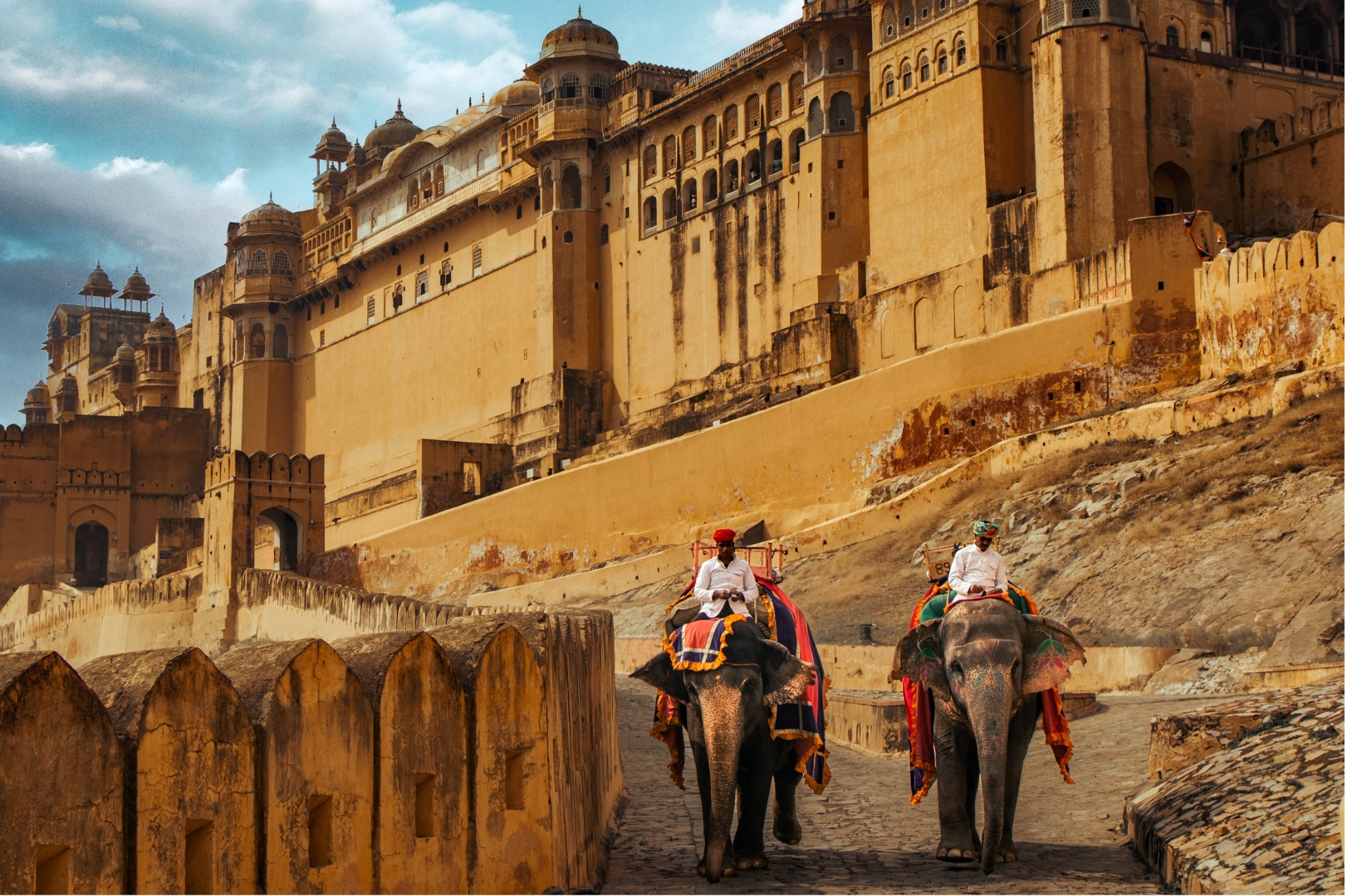
Evening Golden Hour
5:00–6:30 PM (winter) / 5:30–7:00 PM (summer). The evening light in Jaipur has a quality specific to desert cities: warm, deeply directional, and free of the moisture haze that softens coastal golden hours. Nahargarh Fort‘s hilltop terrace is the standout evening location — the city spreads below in shades of rose and ochre, and the descending sun backlights the jagged Aravalli ridge. The water reflection at Jal Mahal also holds evening light beautifully, with the palace appearing to float on a mirror of gold. Patrika Gate‘s painted archways, which face west, are at their most vivid in the last 45 minutes before sunset.

What to Wear for a Jaipur Photoshoot
Jaipur’s visual identity — rose-pink sandstone, saffron marigold garlands, turquoise tilework, and terracotta earthworks — creates an unusually demanding backdrop for wardrobe choices. The city’s palette is saturated and warm; outfits need to complement rather than compete with it, while also working across locations that range from ornate Mughal-era courtyards to sun-bleached hilltop forts and mirror-studded palace chambers.
Couples
The colour combination that consistently produces the strongest results against Jaipur’s architecture: ivory or warm cream paired with a jewel tone. Ivory holds its own against the pale sandstone of Amer Fort and the whitewashed sections of City Palace without becoming overexposed in bright light. Against it, a deep emerald, cobalt blue, or rich burgundy for one partner creates contrast that reads beautifully against both the warm stone and the blue desert sky.
Avoid matching shades of pink or red near Hawa Mahal and the old city walls — the architecture already saturates the frame with rose tones, and clothing in the same palette disappears into the background. Similarly, avoid stark white near marble surfaces (Birla Mandir, the inner chambers of City Palace), where the camera struggles to hold detail in both the fabric and the reflective architecture simultaneously.
For evening sessions at Nahargarh or Jal Mahal: the fading light is warm and amber-toned, which means cool colours — dusty blue, soft mint, pale lavender — gain an unexpected warmth and glow in a way that doesn’t happen in other lighting conditions.
- Avoid: matching pink or red tones near Hawa Mahal or the old city walls, stark white near marble surfaces (Birla Mandir, City Palace inner chambers), and busy patterns that compete with carved stonework or mirror inlays.
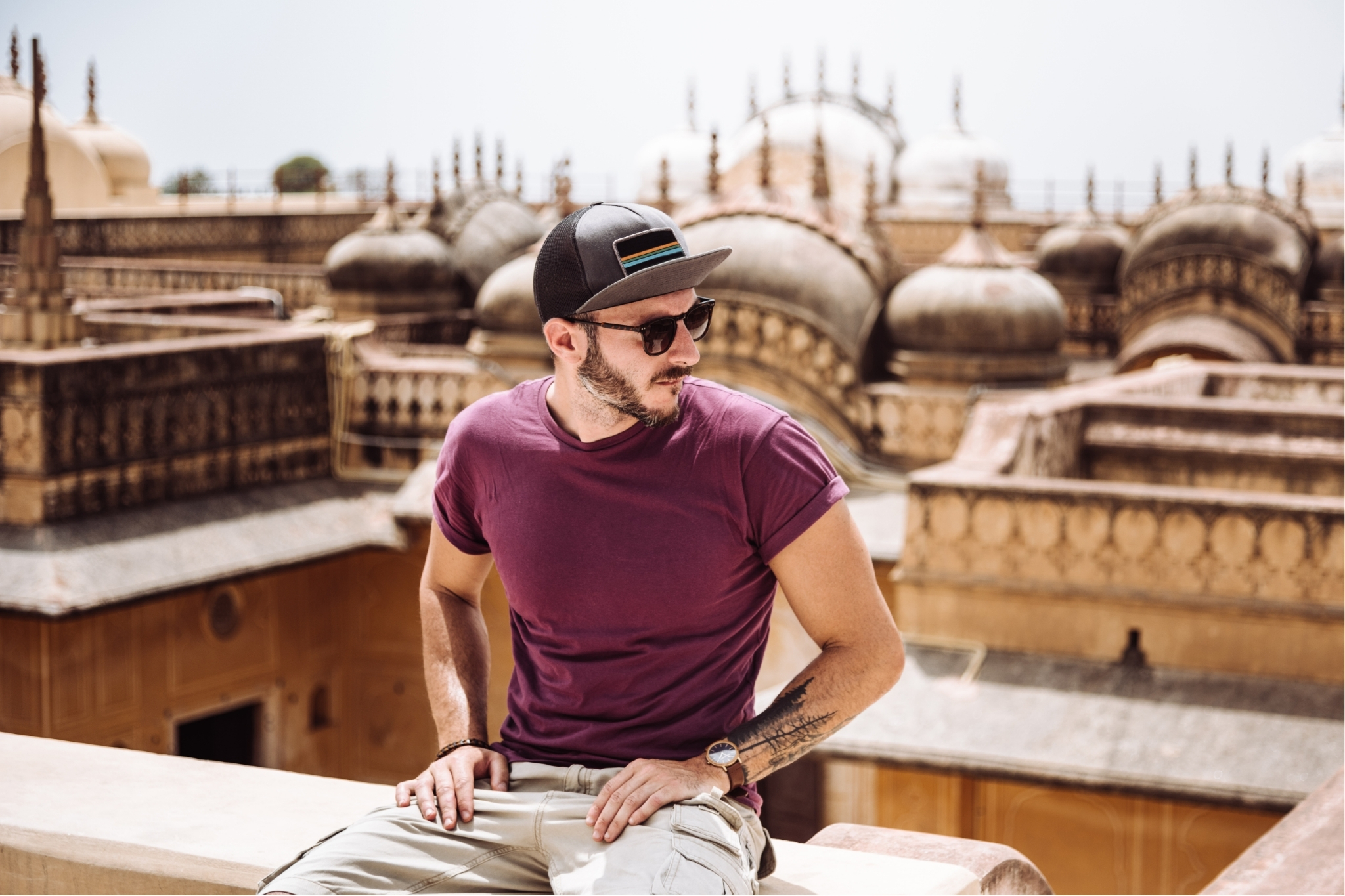
Families
Jaipur’s best family locations — Amer Fort, Patrika Gate, the Nahargarh terraces — involve significant walking on uneven stone, steep ramps, and sometimes large crowds. Coordinated outfits work far better than matching ones, and the logistics of the locations should drive fabric choices as much as aesthetics.
A palette that photographs consistently well across Jaipur’s different backdrops: use the city’s own sandstone as your reference point. Soft terracotta, warm marigold, and dusty coral are not fighting the architecture — they are extending it, creating images where the family feels embedded in the location rather than photographed in front of it. A neutral cream or warm white for one family member anchors the palette and prevents it from reading too warm.
Practical note specific to Jaipur: Amer Fort’s entry involves a steep cobbled ramp or elephant ride — neither is manageable in heels or smooth-soled fashion footwear. Dress for the location from the ground up: closed-toe shoes or sturdy sandals with grip are essential, and thin or loose fabric (linen, cotton, light silk) is far more comfortable than synthetics in a city where even winter afternoons can reach 24°C.
- Avoid: heels and smooth-soled fashion footwear (Amer Fort’s ramp and uneven steps require grip), heavy synthetics in warm months, and fully matching outfits across generations (coordinated tones photograph better than identical clothing).

Family photoshoot by Navin, Localgrapher in Jaipur
Solo Travelers
Jaipur rewards bold, single-statement colour for solo shoots in a way that few cities can sustain. The ornate carved backdrops of Patrika Gate’s twelve painted archways — each representing a different zodiac sign in a different colour — are designed to be complemented by vivid human presence. A single figure in a flowing saffron or deep teal outfit against those hand-painted archways creates images with a graphic power that is hard to manufacture anywhere else in the world.
At the less decorative locations — Nahargarh’s austere hilltop, the clean geometry of Jantar Mantar — a more minimal approach works better: a single tailored piece in a solid jewel tone, with the architecture providing all the texture. The principle is to match the complexity of your outfit to the complexity of your backdrop: simpler fort walls need more visual interest from the clothing; the intensely decorated Patrika Gate needs less.
- What to avoid everywhere in Jaipur: small, busy prints and micro-patterns. Against Jaipur’s intricate tilework, carved jali screens, and mirrored inlays, small-repeat patterns in clothing create visual noise and compete with the architectural detail rather than complementing it. A single bold colour always outperforms a busy pattern in this city.
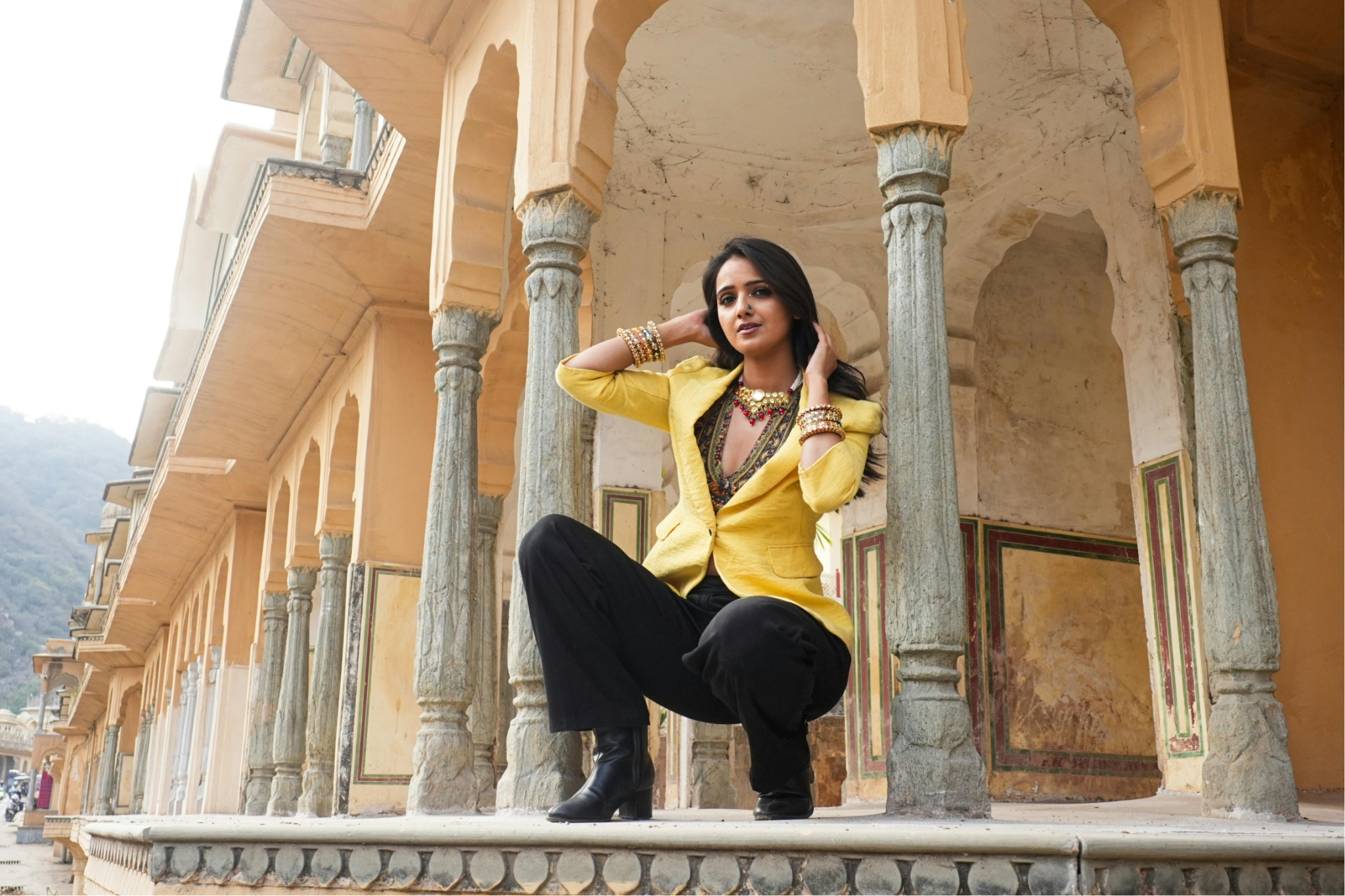
Types of Jaipur Photoshoots
Looking for Jaipur photoshoot ideas? Few cities offer such a dramatic range of settings within such a concentrated area. In a single morning, a photographer can move from the mirrored interior of Amer Fort’s Sheesh Mahal to the painted archways of Patrika Gate to the hilltop panorama of Nahargarh — three completely distinct visual worlds within forty minutes of each other.
Couples
Couple photoshoots in Jaipur work best with a two-location structure that uses the morning window efficiently. A sunrise session at Amer Fort — arriving at the gate by 6:30 AM to catch the first light on the ramparts and the still waters of Maota Lake below — delivers intimate, cinematic imagery with the fort almost entirely to yourselves. A second session in the late afternoon at Nahargarh’s rooftop terrace or Patrika Gate gives a completely different aesthetic register: open sky, wide vistas, and the vivid painted architecture that defines the Pink City’s identity. Couples who can only commit to one session typically choose Amer Fort: it offers the greatest variety — interior corridors, exterior ramparts, courtyard reflections, and lake views — within a single location.

(Secret) Proposal
Proposal photoshoots in Jaipur work particularly well in two locations: the rose garden courtyard within Amer Fort’s inner compound, and the upper terrace of Nahargarh Fort at sunset. Both offer natural sightlines that allow a photographer to remain completely out of frame while staying close enough to capture the full sequence of the moment. The Amer Fort inner courtyard has a central fountain that provides a natural staging point, and the enclosed garden walls mean your photographer can work from behind carved screen panels without being visible. For exact positions, signals, and wet-weather contingency plans, see our dedicated Jaipur proposal guide.

Family
Family photoshoots in Jaipur thrive at Amer Fort and Patrika Gate. Amer Fort is the stronger choice for families with children — the scale of the architecture makes wide-angle family portraits feel genuinely epic, and the variety of settings within the fort means a 90-minute session rarely exhausts a single location. The long entry ramp, if timed before the elephant procession begins, makes a beautiful natural frame for family portraits. Patrika Gate’s twelve painted archways are shorter, more contained, and easier to manage with young children: each archway is a self-contained backdrop that works for individual portraits as well as group shots.

Family photoshoot by Navin, Localgrapher in Jaipur
Honeymoon
Honeymoon photoshoots in Jaipur are ideally split across two sessions: a sunrise fort session at Amer on day one for the romantic, intimate side of the city, and a golden-hour session at Nahargarh or Jal Mahal on day two for something more cinematic and panoramic. The visual contrast between Amer’s enclosed marble courtyards and the open desert skyline at Nahargarh tells a richer story than either location alone — architecture and landscape, intimacy and scale. Not sure which package covers two sessions? The Jaipur photographer cost breakdown explains exactly what each session length includes.

Solo Traveller
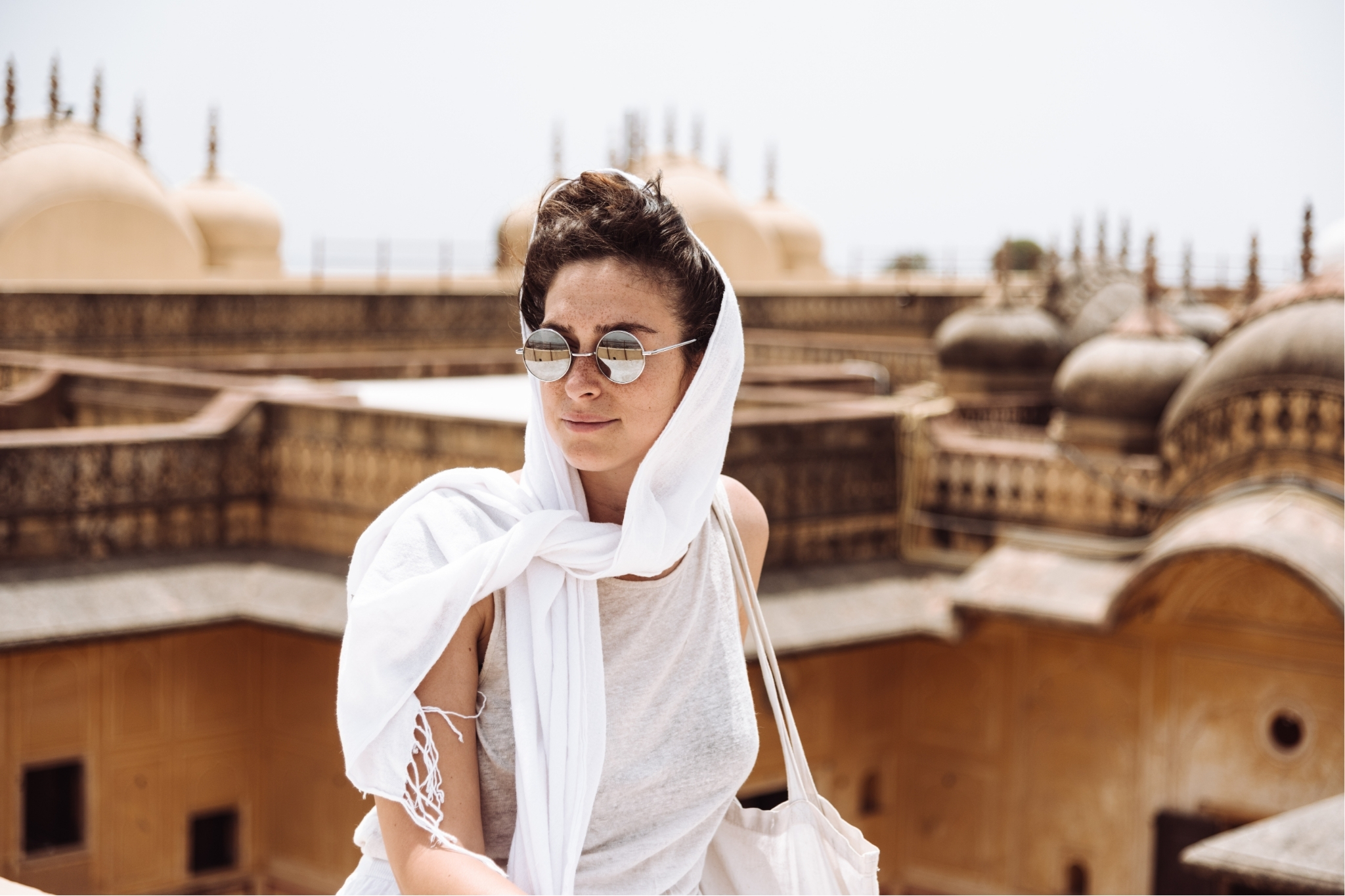
Solo travel shoots have grown significantly in Jaipur, with Patrika Gate and the rooftop terraces of the old city among the most-requested locations. Note that Amer Fort charges an entry fee of approximately $3.60 (₹300) for foreign visitors, which is not included in any Localgrapher package — but your photographer will accompany you inside and knows the exact timing and positioning for every section of the site.
How to Prepare for Your Jaipur Photoshoot
A well-prepared Jaipur session runs on a different schedule from one where logistics are sorted on the day. Amer Fort’s morning crowd pattern, the old city’s traffic, and the intense seasonal light all reward advance planning with a specificity that matters more here than in most cities.
Before Your Shoot
- Confirm your precise meeting point at least 48 hours in advance. For Amer Fort, this means agreeing on a specific spot — the car park at the base of the ramp, not just “Amer Fort” — since the site is large and the surrounding area is busy with tour operators and auto-rickshaw drivers from 7:00 AM onward.
- Check the opening times of your chosen location. Amer Fort opens at 8:00 AM for standard entry. For pre-opening access (which delivers dramatically better light and empty courtyards), your photographer will advise on current options — this changes seasonally and should be confirmed in your pre-shoot briefing.
- For Patrika Gate: it is a public space with no entry fee, but weekend mornings attract larger crowds than weekdays. If your schedule allows, a Tuesday or Wednesday morning session between 6:30 and 8:00 AM will give you significantly cleaner compositions than a Saturday.
- Communicate your priority shots in advance. If you want the reflection shot at Maota Lake below Amer Fort, the mirrored ceiling of the Sheesh Mahal, or a specific archway at Patrika Gate, tell your photographer before the session — each requires precise positioning and timing that cannot be improvised on arrival.
- Plan for the entry fee at Amer Fort ($3.60 / ₹300 per person for foreign nationals), which is not included in the package price. Bring cash — card machines at the ticket counter are not always reliable.

On Shoot Day
- Arrive 15 minutes early. Jaipur’s old city traffic between the hotels on MI Road and Amer Fort can be unpredictable, and the final stretch of the Amer road is single-lane with no good overtaking options once the morning traffic builds after 8:00 AM.
- Dress for the physical demands of the location, not just the camera. Amer Fort’s interior involves multiple staircases with uneven risers and no handrails in some sections. Nahargarh’s approach is a stepped path. Neither is manageable in heels or smooth-soled shoes — plan footwear that is both photogenic and functional, or bring a second pair to change into for walking.
- For January morning sessions near Maota Lake or on exposed hilltop locations like Nahargarh: temperatures before 8:00 AM can drop to 8–10°C. Bring a layer that can be removed once the session begins — your photographer will be moving and won’t feel the cold; you’ll be standing still for composition adjustments.
- For the old city bazaars (Johari Bazaar, Bapu Bazaar): these open later than the forts and are most photogenic between 10:00 AM and noon, when the market is fully set up but before the afternoon heat empties the streets. If your session includes a street market element, plan the bazaar component after the fort, not before.

What Happens After Your Jaipur Photoshoot
The session is done — here’s what to expect from delivery and your final gallery.
Days After the Shoot
- Editing and delivery: Your photographer submits the selected images to our editing team within 24–48 hours of the session. Your finished, professionally edited gallery is delivered within four business days via a password-protected online link. Most clients travelling through Rajasthan on a multi-city itinerary — Jaipur to Jodhpur to Udaipur — receive their gallery before they’ve completed the circuit.
- How many photos: The number of edited images depends on your package. The Bronze package (30 minutes) delivers 20 edited photos, the Silver (60 minutes) delivers 35, the Gold (100 minutes) delivers 60, and the Platinum (120 minutes) delivers 75. Each image is colour-corrected, exposure-balanced, and retouched — not simply exported.
- Storage: All images are stored securely for two years after delivery. If you lose access to your gallery link, contact us at hello@localgrapher.com and we’ll restore access.
- Selecting favourites: Your gallery allows you to download every image included in your package. You don’t need to select a subset — all delivered images are yours.

Jaipur Photoshoot FAQ
What is the best time of year for a photoshoot in Jaipur?
November through February is the standout window: the desert air is clear, temperatures sit at a comfortable 12–24°C (54–75°F) during the day, and the morning light on Jaipur’s sandstone architecture has a warm, directional quality that photographers travel specifically to capture. October is also strong — underrated and increasingly popular as the monsoon dust settles and the first genuinely golden light returns. Avoid May and June if at all possible; the heat reaches 45°C (113°F) and outdoor sessions become physically demanding for everyone involved.
How early should I book a Jaipur photoshoot?
For the November–February peak season, we recommend booking two to three weeks in advance, particularly if you have a specific photographer preference or a date that falls around a major festival. Jaipur is a popular destination for domestic Indian tourism as well as international visitors, and photographers fill up fast around Diwali (October–November) and the Jaipur Literature Festival (late January). Outside peak season, one week’s notice is usually sufficient. For last-minute requests, email hello@localgrapher.com and we’ll do our best to accommodate.
What are the best locations for a Jaipur couple photoshoot?
Amer Fort at sunrise is the most consistently requested location — the mirrored Sheesh Mahal, the Maota Lake reflection, and the long entry ramp lit by the first desert sun together make it the strongest single location in the city for couples. Patrika Gate is the standout choice for colourful, graphic imagery: the twelve hand-painted archways provide a self-contained studio that works in any light. For evening sessions, Nahargarh Fort‘s rooftop terrace and Jal Mahal’s lakefront offer panoramic golden-hour backdrops that feel entirely different from the fort interiors. Many couples combine two locations across the Gold or Platinum packages — your photographer will advise on the best pairing based on your session length and aesthetic.
Is Patrika Gate worth including in a Jaipur photoshoot?
Yes — it’s one of the most visually distinctive locations in Rajasthan and involves no entry fee. The gate’s twelve arches, each painted in a different regional style representing a different Rajasthani city, create a series of naturally vivid backdrops that work for solo, couple, and family formats. The key is timing: arrive before 8:00 AM on a weekday to avoid crowds, and position your session to use the arch that faces east for morning light, or west for late afternoon. Your photographer will know exactly which arch works best for your chosen time slot.
What’s included in a Jaipur family photoshoot package?
Every package includes a private session with a handpicked local photographer, location recommendations tailored to your group size and ages, posing guidance, and professionally edited images delivered within four business days. Entry fees (Amer Fort: approximately $3.60 / ₹300 per person for foreign nationals), transport, and refreshments are not included. For families of five or more, the Platinum package (120 minutes, 75 photos) gives the most time and flexibility — particularly at Amer Fort, where the variety of settings means larger groups can use more of the session time to best effect.
A Jaipur photoshoot rewards precision more than almost any other city in India. Know your golden hour window — it is genuinely narrow and genuinely extraordinary. Understand how the season shapes the desert light. Dress for the architecture and the temperature in equal measure, and communicate your priority shots to your photographer before you arrive. Whether it’s a sunrise couple session at Amer Fort, a family portrait at the painted arches of Patrika Gate, or a solo shoot through the old city’s saffron-draped bazaars, Jaipur is one of the most visually rewarding photoshoot destinations in all of Asia.