
The best Singapore photo spots are Marina Bay Sands at sunrise, Gardens by the Bay at the Supertree light show, Haji Lane for shophouse murals, and Chinatown for lantern-lit alleys. Most cost nothing, all sit on the MRT, and the equatorial light moves fast. Below, we map the exact times, angles, transport fares, and crowd patterns local photographers use.
We are Dirgan, Jaden, and Amsyar, three of the Singapore photographers based here. Between us, we have walked these blocks at every hour, in every kind of weather, for years. We know the guard at Marina Bay Sands who unlocks the promenade gate around 6 AM, the corner of Haji Lane where the sun lands flat on the murals around 9:30 AM, and the spot in Gardens by the Bay where the Supertrees frame the financial-district skyline cleanly. These are the best places for photos in Singapore. What follows is not a tourist checklist, but an honest insider map of where the light lands, when the crowds disappear, and what TripAdvisor will not tell you.
1. Marina Bay Sands
Marina Bay Sands is the silhouette every Singapore feed is built on. Three towers, a 150-meter rooftop pool deck, and a financial-district skyline that lights up from the east at first light. The best angle is not from the hotel itself, but from the opposite bank: stand on the bridge between the Esplanade and the Helix, and the towers anchor the right side of your frame with the water glassy out front.
Marina Bay Sands
Best time: Sunrise lands around 6:50 AM year-round; arrive by 6:30 AM to scout your spot. The towers stay backlit and clean until around 8 AM, after which the financial district crowd begins.
Position: Walk to the midpoint of the Jubilee Bridge, just south of the Esplanade. From there, the towers sit at the far end of the bay with the Helix Bridge curving in from the left.
Fee: Free at the bay level. SkyPark Observation Deck on the rooftop costs $24 (SGD 32) for adults if you want the reverse angle looking down.
Transport: Bayfront MRT (CE1/DT16), Exit B or C, then a 5-minute walk along the covered promenade. Standard MRT fare runs $1.20 (SGD 1.60).
Crowd tip: Weekday mornings before 7 AM are quieter than weekends. Wednesday around 6:30 AM is the cleanest morning of the week.
Photo tip: Position your subject so the leftmost tower lines up just above their shoulder. Our photographer will guide you to face slightly toward the rising sun so the warm light catches your jawline rather than flattening your face.

“Marina Bay Sands looks staged in postcards. The trick is to make it feel like the city woke up around you. I shoot from the bridge so the bay reflects the towers and we get the human moment in the foreground.”
– Amsyar, Localgrapher photographer in Singapore
2. Gardens by the Bay
Gardens by the Bay is the cinematic counterweight to Marina Bay Sands, right across the road. The Supertree Grove is what most travelers come for, but few realize the framing changes completely between daylight and the 7:45 PM light show. By day, you get scale: 18 vertical gardens fanning out against the sky. By night, you get color: synchronized lights timed to music every evening at 7:45 PM and 8:45 PM.
Gardens by the Bay
Best time: Around 7:30 PM for the first light show, when the sky still holds blue, and the trees ignite. Daytime works best around 9 AM before humidity kicks in.
Position: The clean shot is from the OCBC Skyway above, but the most-photographed angle is from ground level on the south side of the grove, looking up so the trees radiate outward.
Fee: Supertree Grove and outdoor gardens are free. OCBC Skyway costs $9 (SGD 12). The conservatory domes (Flower Dome and Cloud Forest) cost $40 (SGD 53) for a combo ticket.
Transport: Bayfront MRT (CE1/DT16), Exit B, then follow the covered walkway for around 10 minutes through the basement of the hotel complex.
Crowd tip: Weekday light shows draw smaller crowds than weekends. Skip the 8:45 PM show in favor of the 7:45 PM, which has blue-hour sky behind the trees.
Photo tip: Stand under the central canopy and look straight up: the trees radiate out from your subject. Our photographer will frame you low and wide so the lights wash across the whole composition.

3. Haji Lane
Haji Lane is a 200-meter sliver of low-rise shophouses crammed with murals, indie boutiques, and cafes in the Kampong Glam neighborhood. The colors are saturated, the building heights are short, and the light bounces beautifully between the painted walls. For Instagram spots in Singapore, this is the densest cluster per square meter in the city. The trick is timing: the lane sleeps until around 11 AM, and that is your golden window.
Haji Lane
Best time: Between 9:30 AM and 10:30 AM. The sun is high enough to clear the rooftops, but the shops are still closed, so the lane is empty and the murals are unobstructed.
Position: Start at the Beach Road end and walk east. The most-photographed mural (the multicolored portrait wall on the north side) sits around halfway down. Step back to the opposite sidewalk for the full frame.
Fee: Free.
Transport: Bugis MRT (EW12/DT14), Exit B, then a 5-minute walk north along Ophir Road. Fares around $1.20 (SGD 1.60).
Crowd tip: Sundays before 10 AM are the quietest. By noon on a weekend, the lane is a stream of phones, so commit to the morning slot.
Photo tip: Wear a solid color that contrasts with the murals (cream, navy, soft pink) so you stand out from the busy backdrop. Our photographer will position you a meter from the wall so the colors stay sharp behind you.

4. Merlion Park
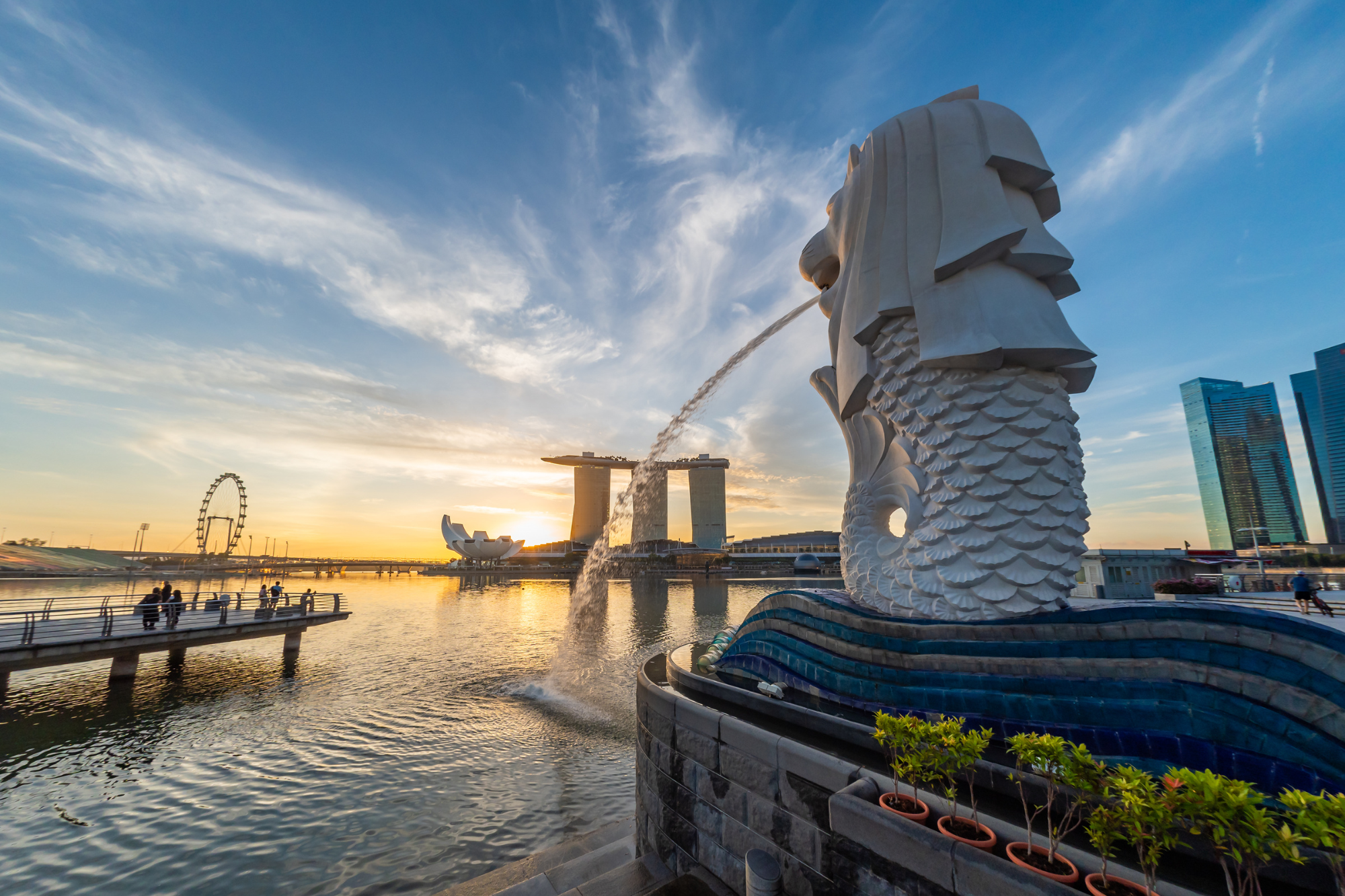
The Merlion is the city’s official mascot: half lion, half fish, eight meters tall, spraying water into the bay since 1972. The classic shot is the lion in profile with Marina Bay Sands on the horizon, but the better one is taken from the south, where the water bridges the two icons, and you get reflection, plus skyline, plus statue in a single composition.
Merlion Park
Best time: Around 6:45 AM at sunrise; soft, warm light hits the statue’s face and the Helix Bridge from the east. By around 8 AM, the tour groups start arriving in waves.
Position: Step around 30 meters left of the main viewing platform so you have open water between you and the lion. From here, the towers sit cleanly behind the statue’s right shoulder.
Fee: Free.
Transport: Raffles Place MRT (NS26/EW14), Exit B, 8-minute walk through the financial district. Fares around $1.20 (SGD 1.60).
Crowd tip: Sunday around 6:30 AM is the quietest morning of the week. Avoid weekday lunchtime when office workers cut through the park.
Photo tip: The Merlion sprays water, and the spray drifts on the breeze. If the wind is from the south, stand on the north side, or your camera will fog up in around 30 seconds. Our photographer will check the breeze direction before posing you.
5. Chinatown
Chinatown is the cultural counterweight to the glassy skyline: red lanterns strung over Pagoda Street, the Buddha Tooth Relic Temple’s three-tiered facade, and incense drifting out of the side alleys at Smith Street. This is where Jaden has been shooting cultural portraits for years, and it remains one of the most layered Singapore photo spots if you arrive early enough to beat the souvenir crowds.
Chinatown
Best time: Around 6:30 AM to catch the lanterns still lit against a pre-dawn sky, with shutters closed and streets empty. Alternatively, around 7 PM for a warm lantern glow without daytime crowds.
Position: Stand at the south end of Pagoda Street looking north; the rows of lanterns funnel toward the Buddha Tooth Relic Temple in the background.
Fee: Free to walk and shoot the streets. The Buddha Tooth Relic Temple is free to enter, but ask before photographing inside.
Transport: Chinatown MRT (NE4/DT19), Exit A puts you directly on Pagoda Street. Fares around $1.20 (SGD 1.60).
Crowd tip: Lunar New Year (typically late January or February) brings dense crowds and stunning decorations, but skip weekend afternoons year-round.
Photo tip: Look up. The lanterns sit roughly four meters overhead, and tilting your camera up so they fill the top third of the frame keeps the busy street out and the color in. Our photographer will guide you to stand slightly off-center for asymmetry.

“Chinatown is where Singapore tells you about itself. I look for the small things: the steam off a kopitiam, the cat asleep on a temple step. That is the city when nobody is performing.”
– Jaden, Localgrapher photographer in Singapore
6. Botanic Gardens
The Singapore Botanic Gardens is the country’s only UNESCO World Heritage site, opened in 1859, and the green lung that local couples have used for engagement shoots for decades. The most underrated angle is not the famous swan-flecked lake, but the rainforest grove just north of it, where towering trees filter the morning light into long shafts across the path. This is where our Singapore photography team goes for engagement portraits all year round.
Botanic Gardens
Best time: Around 7:15 AM. The gates open at 5 AM, light filters cleanly through the canopy until around 9 AM, and the joggers thin out by 8:30 AM.
Position: Enter through Tanglin Gate, then walk five minutes to Swan Lake. The footbridge over the lake gives you the classic gardens shot: water in front, gazebo behind.
Fee: Free for the main gardens. The National Orchid Garden costs $11 (SGD 15).
Transport: Botanic Gardens MRT (CC19/DT9), Exit A drops you at Bukit Timah Gate. Fares around $1.20 (SGD 1.60).
Crowd tip: Weekday mornings are empty by local standards. Saturday, around 7 AM, brings tai-chi groups, but they cluster near the bandstand, not the lake.
Photo tip: Stand on the lake footbridge facing east and have your subject look down at the water. The reflection adds depth without you needing to do anything special. Our photographer will angle you to catch the orchids in the background corner.

7. East Coast Park
East Coast Park is the local antidote to the downtown frenzy: a 15-kilometer ribbon of beach, casuarina trees, and bike paths that locals retreat to on weekends. It is also where you take photos in Singapore that look nothing like Singapore at all, no skyline in the frame, no MRT, just a flat horizon and the Strait of Singapore. Gary has spent more sunrises here than he can count.
East Coast Park
Best time: Around 6:30 AM for sunrise over the strait. The water flattens to glass for around 20 minutes after first light, and cargo ships sit perfectly on the horizon.
Position: Park Area C, just east of the Marina Barrage end. Stand on the wet sand at the waterline, and the curve of the beach trails left into the frame.
Fee: Free.
Transport: Marine Parade MRT (TE26) is closest, then a 10-minute walk south through the underpass to the park. Fares around $1.20 (SGD 1.60).
Crowd tip: Weekday mornings are empty apart from a few joggers. On weekends, the park hosts barbecues by 11 AM, so finish your shoot before 9 AM.
Photo tip: Take off your shoes. Have your subject walk slowly along the waterline so the sand stays wet and reflective. Our photographer will keep low so the horizon line sits high in the frame.

8. Esplanade
The Esplanade Theatres on the Bay is the spiked-glass building locals call the durian. It is one of the cleanest spots for where to take photos in Singapore at twilight, when the lights inside come on, and the geometric shell glows from within. The rooftop garden is open to the public, and almost no traveler thinks to climb it.
Esplanade
Best time: Around 7 PM for the building lights coming on against blue-hour sky. From the rooftop, you also catch Marina Bay Sands on the bay across the water.
Position: Take the elevator inside the Esplanade Mall to the Roof Terrace level. Walk to the bay-facing edge and frame the towers through the railing for added foreground.
Fee: Free.
Transport: Esplanade MRT (CC3), Exit D leads straight into the building. Fares around $1.20 (SGD 1.60). Alternatively, City Hall MRT (NS25/EW13) Exit C is a 6-minute walk.
Crowd tip: The rooftop closes at 11 PM. Most performance crowds are inside the building by 7:30 PM, so the terrace is yours.
Photo tip: Place your subject so the durian-spike pattern fills the background behind them. Our photographer will move you slightly so a single warm window light sits over your shoulder.

9. Tiong Bahru
Tiong Bahru is the country’s oldest public-housing estate, built in the 1930s in streamline-modern style, with curved facades, low-rise blocks, and a coffee-shop culture that pre-dates the high-rises by decades. The lane between Block 71 and Block 81 has the cleanest art-deco facade in the city, and the morning light at around 8 AM hits it from the right angle to bring out the period detail.
Tiong Bahru
Best time: Around 8 AM, after sunrise but before the cafe queues form. The facades catch warm side light from the east.
Position: Stand at the corner of Tiong Bahru Road and Eng Hoon Street, facing the curved block at 78 Moh Guan Terrace. The streamlined wall fills the frame from end to end.
Fee: Free.
Transport: Tiong Bahru MRT (EW17), Exit A, 8-minute walk west along Tiong Bahru Road. Fares around $1.20 (SGD 1.60).
Crowd tip: Weekday mornings are quiet apart from elderly residents heading to the wet market. Weekend afternoons fill with cafe crowds, so stick to the morning slot.
Photo tip: The buildings are pastel and matte. Wear something solid and dark (charcoal, deep green, navy), so your subject does not blend into the wall. Our photographer will keep you on the sunny sidewalk so the shadows behind you stay soft.

10. Clarke Quay
Clarke Quay is the riverside nightlife stretch on the Singapore River, all painted shophouses, bumboats, and brightly lit awnings reflected in the water. Daytime is dead; the spot only earns its place after around 6:30 PM, when the lights come on, and the river turns into a long mirror. Ben has shot more couple portraits here than anywhere else in the city.
Clarke Quay
Best time: Around 6:45 PM, just as the warm lights ignite over Read Bridge and the sky still holds residual blue. The lights stay strong until around 10 PM.
Position: Stand on Read Bridge facing south. The Clarke Quay frontage sweeps left to right, and the river reflects the entire row.
Fee: Free to walk and shoot the riverfront. River-taxi rides cost $7 (SGD 9) one way if you want the moving-boat angle.
Transport: Clarke Quay MRT (NE5), Exit C or E, immediately to the riverfront. Fares around $1.20 (SGD 1.60).
Crowd tip: Friday and Saturday after 9 PM are wall-to-wall club-goers; Tuesday through Thursday evenings give you the visual energy without the press of people.
Photo tip: The water is still and reflective, so the lower half of your frame is a free mirror. Our photographer will position you in front of the river so the reflection doubles the color behind you.

“Clarke Quay only works when the city slows down enough for you to notice it. I shoot for the moment between drinks and dinner, when the light is on and the night has not started yet.”
– Ben, Localgrapher photographer in Singapore
Best Time of Day to Shoot in Singapore
Singapore sits one degree north of the equator, which means daylight runs almost exactly 12 hours every day of the year. The sun rises around 7 AM and sets around 7 PM, with only 15 minutes of seasonal drift. What changes is not the timing but the weather window. Below is how the day breaks down for shooting at the best Singapore photo spots, regardless of the month.
When to Shoot in Singapore
Morning golden hour (around 6:50 AM to 7:30 AM): The cleanest light of the day, warm and low across the bay. Marina Bay, Merlion Park, and East Coast Park all peak here.
Late morning (around 7:30 AM to 11 AM): Light gets stronger but stays usable if you shoot on the shady side of buildings. Haji Lane and Tiong Bahru are best in this window.
Midday (around 11 AM to 4 PM): Harsh equatorial sun directly overhead. Skip outdoor portraits unless you have full shade. This is when our photographers move to interiors: the conservatory domes, the Buddha Tooth Relic Temple, or the National Museum.
PHOTO
Afternoon golden hour (around 6:30 PM to 7:00 PM): Shorter than morning, around 30 minutes of usable warm light. Best from the Esplanade rooftop or the Helix Bridge.
Blue hour (around 7:00 PM to 7:30 PM): The 25 minutes when ambient sky balances the building lights. Marina Bay Sands, Gardens by the Bay, and Clarke Quay all peak here.
Singapore by season:
- Northeast monsoon (November to January): heavier afternoon rain; plan morning shoots and have a covered backup like Chinatown or the Esplanade interior.
- Inter-monsoon (March, April, October): hottest and most humid; humidity often hits 90 percent by 9 AM.
- Southwest monsoon (June to September): the driest months on average; short showers but clearer skies for the blue hour.

Solo photoshoot by Dirgan, Localgrapher in Singapore
“The first hour after sunrise is everything in this city. After that, you are fighting the sun or the crowds, sometimes both. We always start a session by 6:30 AM.”
– Dirgan, Localgrapher photographer in Singapore
FAQ: Singapore Photo Spots
What are the best photo spots in Singapore?
The most photographed Singapore photo spots are Marina Bay Sands at sunrise, Gardens by the Bay during the 7:45 PM light show, Haji Lane around 9:30 AM, Merlion Park around 6:45 AM, and Chinatown at 7 PM. Add Botanic Gardens for greenery, East Coast Park for the strait, Esplanade for blue hour, Tiong Bahru for art-deco facades, and Clarke Quay for nighttime river reflections. All ten sit on the MRT, all are free to enter except the SkyPark deck and the orchid garden.
How do I get to the best Singapore photography locations?
Every spot in this guide is within an 8-minute walk of an MRT station. Buy an EZ-Link card at any station for $9 (SGD 12), which includes $4 (SGD 5) of stored value. Standard adult fares run $1 to $2 (SGD 1.10 to SGD 2.50) per trip. From Changi Airport, the MRT to Bayfront takes around 50 minutes and costs $1.60 (SGD 2.10). Avoid taxis between 6 PM and 8 PM on weekdays, when surge pricing kicks in and traffic clogs the central district.
Why hire a local photographer instead of shooting in Singapore yourself?
The light here is fast, and the humidity is brutal. By 8 AM, the sun is already harsh, and your sunscreen has sweated into your phone screen. A local photographer knows the side gate at Marina Bay that opens at 6 AM, which corner of Haji Lane catches the soft bounce light, and when the Supertree show ends, so you avoid the exit crowds. You also get someone who carries the gear, watches the breeze direction at Merlion Park, and edits the humidity haze out of your final files. Find your Singapore photographer for the day.
When is the best time of year to shoot in Singapore?
Singapore is tropical and shootable year-round; the question is humidity and rain, not season. The driest stretch runs from June through September, with shorter afternoon showers and clearer skies for blue hour. The November-to-January monsoon brings heavier afternoon rain, but mornings often stay clear, so start early. Lunar New Year (late January or February) is the most visually loaded week of the year in Chinatown, but draws the largest crowds. April is the hottest month; plan mornings only.
The best Singapore photo spots reward the early riser. The light moves fast in an equatorial city, the humidity rises with the sun, and every spot we have listed peaks in the first or last hour of the day. The MRT will get you there for under $2, and most of these locations are free to enter. Skip the noon shoot, dress for sweat, and let the city wake up around you. We have photographers ready to meet you at any of them, on the day, with the right lens for the light.
For the full price breakdown, see our Singapore photographer cost guide.