
Taipei photo spots range from the neon-soaked alleys of Ximending to the misty bamboo terraces of Yangmingshan, the lantern-lit railway at Shifen, and the rooftop views behind Taipei 101. Most of them reward photographers who show up at the right hour, and the best months for that are October through April, when the humidity drops, the sky clears, and the evening light lingers. This guide was written with input from Amedee, Kyunghoon, Jeff, Dennis, and the rest of our Taipei photographers who shoot here weekly; not a tourist checklist, but an honest insider map of where the light lands, when the crowds disappear, and what TripAdvisor will not tell you.
1. Taipei 101: The Skyline Shot Locals Actually Shoot
Taipei 101 is the obvious landmark, and that is exactly why most tourists get an underwhelming photo of it. They stand at the base and shoot straight up. Our photographers shoot it from elevation and from distance, and the difference is night and day.
Elephant Mountain at 4:30 PM, Not Sunset
Everyone climbs Elephant Mountain (Xiangshan) for sunset, which is why the Six Giant Rocks viewpoint is elbow-to-elbow at 5:30 PM. Arrive at 4:30 PM instead. The light is still warm enough, the tower catches the late-afternoon sun on its western face, and you can set up on the rocks without waiting in a tripod queue. The climb is steep but short (roughly 20 minutes from the MRT Xiangshan Station exit 2, free entry). For a completely different frame, skip the summit and walk to the lesser-known side path about 5 minutes before the rocks, which frames Taipei 101 through a gap in the trees. That is the shot almost nobody else has.

“I shoot Xiangshan at least twice a week, and I have stopped going for sunset. Around 4:30 in winter, the rocks are nearly empty, and the tower glows without the sky being blown out. It is the single best free viewpoint in the city, and the couples photos I take up there are consistently the ones clients send me back messages about six months later.”
– Amedee, Localgrapher photographer in Taipei
2. Chiang Kai-shek Memorial Hall: The One-Hour Empty Window
The Chiang Kai-shek Memorial Hall is one of the best places for photos in Taipei; blue roofs, white marble, symmetrical staircases, and a plaza wide enough to photograph without crouching. Shoot it at the wrong time, and you are fighting school groups and selfie sticks.
6:30 AM Is the Window Nobody Uses
The gates to the memorial grounds open at 5:00 AM, but the plaza stays nearly empty until around 7:30 AM. Show up at 6:30 AM on a weekday. The light comes in low from the east, the octagonal roof glows cobalt, and the tai chi practitioners on Liberty Square create a natural candid background that is completely unique to Taipei. Entry to the grounds and main hall is free. The most photographed angle is looking up the staircase toward the seated statue, but the cleanest couple’s frame is from the base of the National Theater steps (to your right as you face the hall), with the full memorial behind you and the flag pole slightly off-center. Avoid 10 AM to 4 PM completely; the white marble blows out, and the plaza becomes a reflector oven in summer.

3. Shifen Old Street: Sky Lanterns Without the Crowd Chaos
Five minutes from the city on the Pingxi train line, Shifen Old Street is famous for the sky lanterns released directly over the railway tracks. It is also one of the most complex photography locations in the Taipei area because the tracks are active (the train rolls through every 30–40 minutes) and the timing of the light changes rapidly.
Arrive at 3:00 PM, Release the Lantern at 4:45 PM
The magic window is the 15 minutes before sunset when the sky turns a deep gradient, and the lantern flames glow against the fading blue. Get to Shifen by around 3:00 PM, so you have time to write on the lantern (NT$150–$200/$4.80–$6.40 for a single-color lantern, NT$250/$8 for a four-color), scout the stretch of track just east of the station where the wooden shopfronts flank both sides, and wait out the scheduled train. Release between around 4:45–5:15 PM, depending on the season. The photographer positions low on the tracks (safely between trains), looking upward as the lantern ascends. Getting there: take the TRA train from Taipei Main Station to Ruifang (around NT$44/$1.40), then transfer to the Pingxi line. Total journey around 90 minutes one way. This is one of the most rewarding Taipei photography locations if you are willing to treat it as a half-day trip rather than a quick stop.
4. Yangmingshan National Park: The Season Decides the Shot
Yangmingshan sits roughly 40 minutes north of central Taipei by bus and is one of the few places in the world where you can photograph cherry blossoms, volcanic fumaroles, and silver grass fields within a 20-minute drive of each other.
Zhuzihu Valley Between February and Mid-March
For cherry blossom and calla lily shots, Zhuzihu (Bamboo Lake) is the destination. The valley floor fills with white calla lilies from roughly mid-March through April, and the Yoshino cherry trees peak in the first two weeks of February. Arrive on the first bus (Bus 108 from Jianguo High School stop) around 7:30 AM before the day-tour coaches. From October through early December, shift to Qingtiangang grassland instead; the silver grass fields at golden hour, with Mount Datun as the backdrop, produce a texture you cannot get anywhere else in the city. Entry to the park is free, but Zhuzihu farms may charge NT$100–$150 ($3.20–$4.80) during peak bloom for garden access. Bring a layer; it is 6–8°C cooler at the top than in Taipei proper.

5. Dihua Street: Colonial Facades Most Visitors Walk Past
Most visitors come to Dihua Street for the Lunar New Year market and leave. The quieter southern end, between Minsheng West Road and Nanjing West Road, has some of the best-preserved Qing and Japanese-era shopfronts in Taiwan and is the most underused photography backdrop in the city.
The Baroque Facades Between 7:00 and 8:30 AM
Before the dried-goods shops roll up their shutters at around 9 AM, Dihua Street is quiet enough that you can compose a frame without a single pedestrian in it. The morning light enters from the east, glancing across the pastel-painted baroque facades (pay attention to the stretch around Yongle Market and the Xiahai City God Temple; the color palette there is genuinely unlike anything else in Taipei). The street is narrow, so a 35mm or 50mm lens is ideal; a wide-angle lens compresses the facades and loses the detail. For couples, the wooden doorways of the old medicine shops create a natural frame with zero tourist infrastructure in the background. If you are scouting Dihua for something more than a couples shoot, our Taipei secret proposal guide covers five proposal locations with exact photographer positioning and rain backup plans for each.

“Dihua is my favorite spot for candid storytelling shoots. If we start around 7:15 in the morning, we basically have the whole street; the shopkeepers are just opening up, the light is soft, and the facades photograph like a film set. My clients always expect Taipei to feel like Shibuya, and Dihua is the surprise that reframes the whole trip.”
– Kyunghoon, Localgrapher photographer in Taipei
6. Lungshan Temple: Incense Light You Cannot Manufacture
Lungshan Temple in the Wanhua district is nearly 300 years old and one of the most architecturally photogenic places in the city. The light inside the courtyards shifts dramatically with the incense haze, and that haze is what separates a tourist shot from an editorial one.
The Side Courtyards, Not the Main Altar
Everyone photographs looking at the main altar from the front entrance, which is also where the security staff politely discourages tripods. The more interesting frames are in the two side courtyards, particularly the rear courtyard dedicated to Matsu, where the incense haze pools beneath the carved dragon columns in the mid-morning light (roughly 9:30–10:30 AM). The temple opens at 6:00 AM. Entry is free. Dress code is not strictly enforced, but modest shoulders and knees are appreciated, and do not step on the raised wooden thresholds; step over them. Weekday mornings are noticeably calmer than weekends.

7. Raohe Night Market: Taipei in Neon
The Raohe Night Market is more compact and more photogenic than its bigger rival, Shilin. A single 600-meter strip lit by red lanterns and neon food stalls, capped at one end by the stunning Songshan Ciyou Temple, gives you every Taipei night-market cliche shot in a 20-minute walk, and it is easily one of the best Instagram spots in Taipei if you hit the blue-hour window right.
The Temple Entrance at 6:30 PM Sharp
The best frame is from the south entrance (by Songshan Ciyou Temple), looking down the length of the market as the lanterns come on at around 6:30 PM and the light in the sky still has 15 minutes of blue left. That blue-hour-plus-lantern combination is the difference between a flat night shot and one that looks three-dimensional. Keep your camera close (standard street-photography awareness), and shoot at around f/2.8 or wider to let the neon halos bloom. The market runs until midnight, but fills up dramatically after 7:30 PM, so move fast through the opening window. The nearest MRT is Songshan Station (green line), a 2-minute walk.

“I tell clients who want Taipei to feel like a movie that Raohe around 6:30 is the scene. We walk in while there is still blue in the sky, and by the time we are halfway down the strip, the lanterns are fully on. That transition window is maybe 12 minutes. Miss it, and the photos look like any night market; catch it, and they look like a film still.”
– Jeff, Localgrapher photographer in Taipei
8. Jiufen Old Street: The Hillside Town Worth the Drive
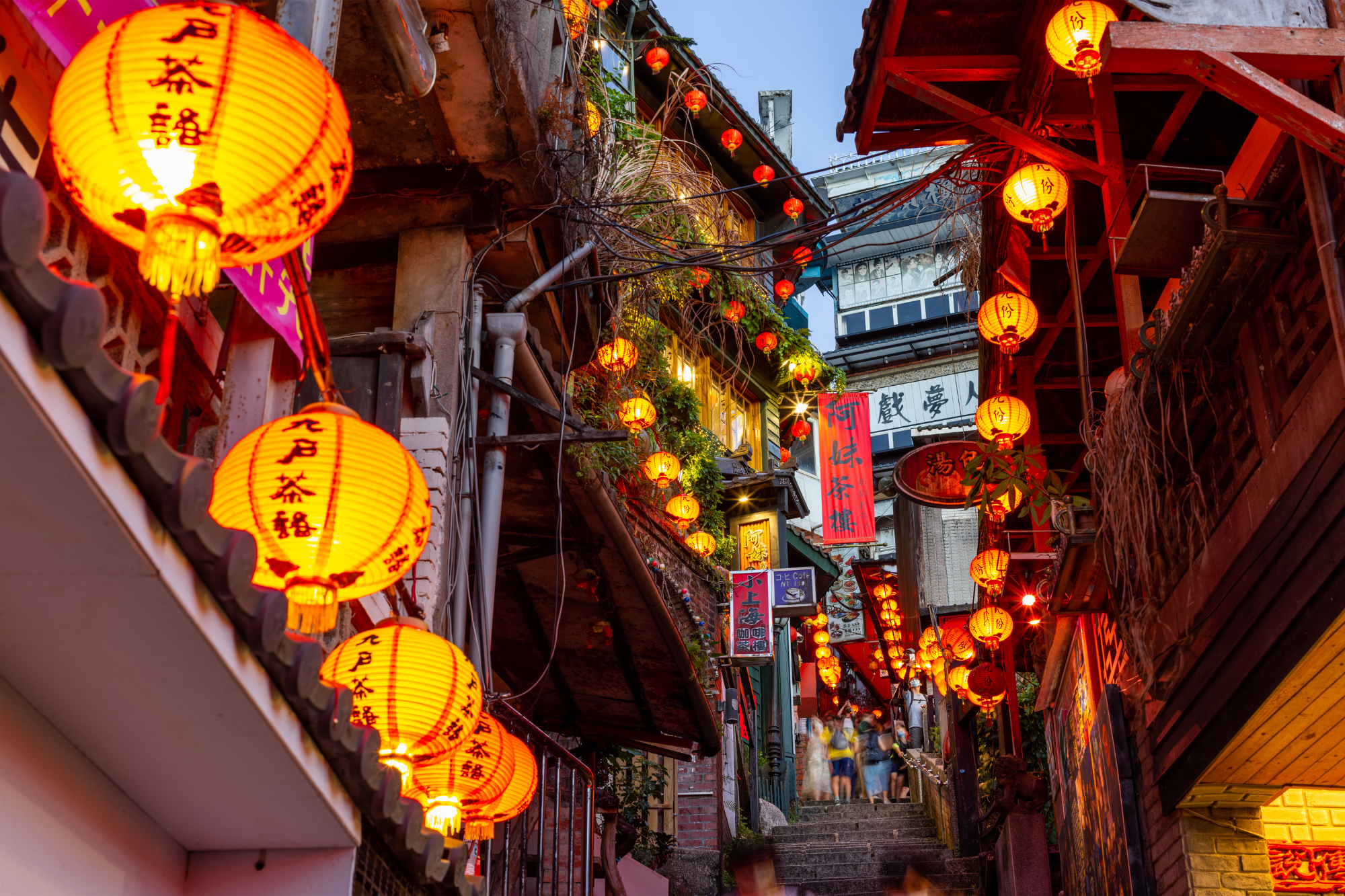
Technically just northeast of the city, Jiufen is one of the most atmospheric hillside towns in northern Taiwan and a favorite day-trip backdrop for our Taipei photography team. The red lanterns, the teahouses stacked on the cliff, the view over Keelung Bay, it is a 45-minute drive from the city, and worth every minute if you plan the timing right.
Amei Teahouse at Dusk, Not Midday
The iconic shot is A-Mei Teahouse lit up with its red lanterns at dusk. The problem: by 6:00 PM on a weekend, Shuqi Road (the staircase alley) is packed shoulder-to-shoulder with day-trippers. Arrive on a Tuesday or Wednesday evening. Park at the public lot (NT$50/$1.60) and walk down. Best frame is from the stone staircase below the teahouse, looking up and slightly to the left, so you catch the lantern line against the dark hillside. Blue hour falls around 5:30–6:00 PM in winter and 6:45–7:15 PM in summer; hit that window, and you will have the teahouse glow against a deep indigo sky. From Taipei, take bus 1062 from Zhongxiao Fuxing MRT (around NT$101/$3.20, 90 minutes) or Grab/taxi (around $30–$40 one way).

9. Beitou Hot Spring Valley: Steam, Stone, and Zero Crowds
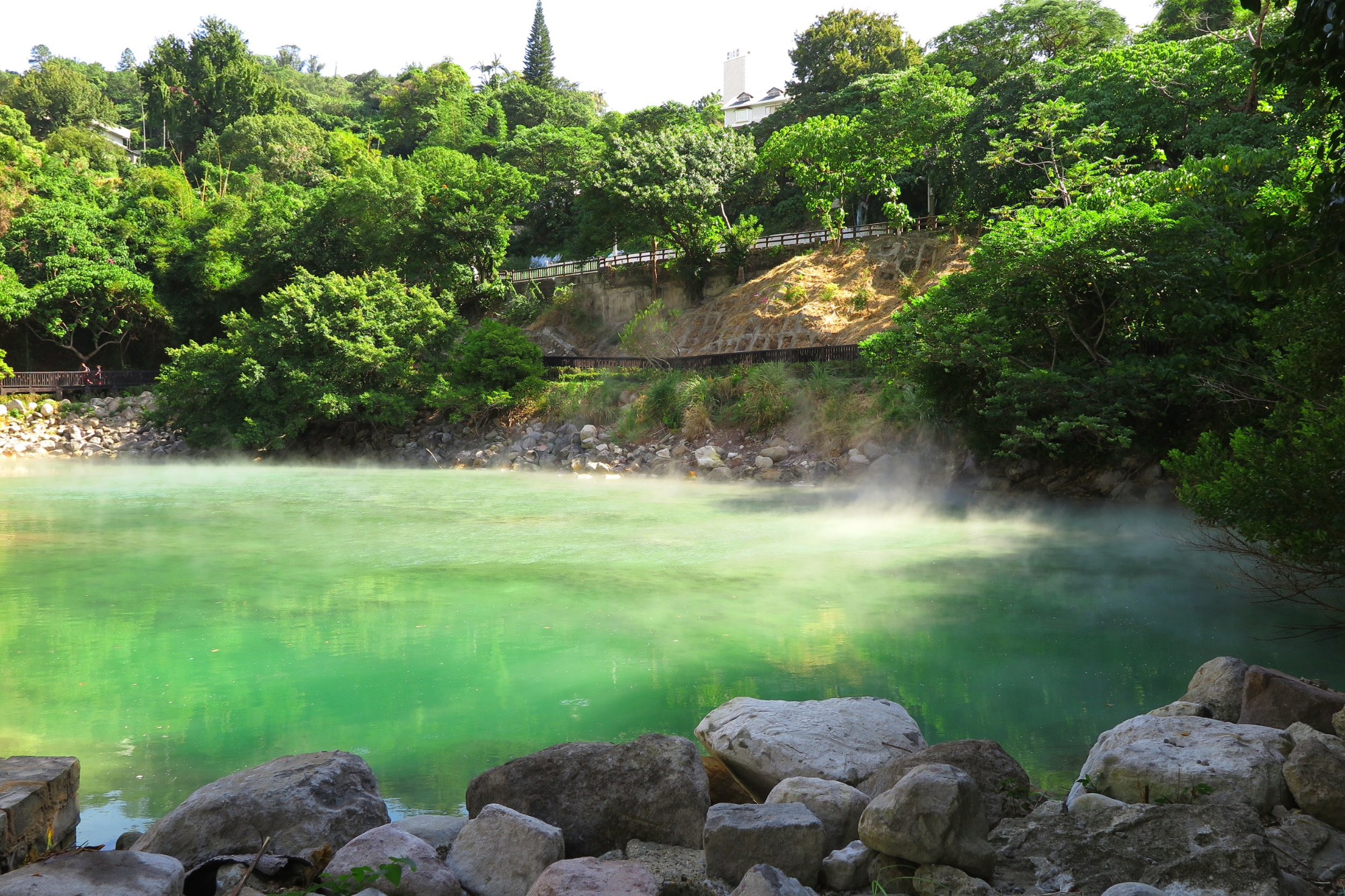
Beitou sits at the northern end of the MRT red line, 25 minutes from Taipei Main Station, and feels like stepping into rural Japan. The sulfur steam rising from the Geothermal Valley (Thermal Valley) creates a natural atmospheric diffuser that is almost impossible to replicate with artificial fog machines.
The Thermal Valley at Opening (9:00 AM)
The Thermal Valley opens at 9:00 AM and closes at 5:00 PM. Arrive at opening for two reasons: the valley is nearly empty, and the morning temperature differential between the 90°C water and the cooler air creates the thickest, most photogenic steam. Entry is free. For portrait work, the stone-walled pathway above the lake is the money shot; the photographer positions on the higher terrace and shoots down through the steam. Do not touch the water (it is literally acidic enough to damage skin), and keep your camera lens cloth handy; sulfur moisture condenses on glass fast. The nearby Beitou Hot Spring Museum (free entry, closed Mondays) is an excellent rain backup with wood-paneled interiors that photograph beautifully under overcast light.
10. Huashan 1914 Creative Park: Indoors, and Genuinely Spectacular
This is the one indoor-outdoor hybrid Taipei photography location on our list, and it is the most overlooked for editorial-style portrait work. Huashan 1914 is a converted sake distillery turned arts complex, with exposed brick warehouses, rusted iron staircases, and courtyard greenery that photographs like a film location.
The Rear Warehouse Block at Around 10 AM
The front galleries are the tourist-photographed zone. Walk to the rear warehouse block (past the cafes, toward the eastern boundary) where the old red-brick facades with climbing ivy and the black iron fire escapes create a texture you cannot find elsewhere in central Taipei. At around 10:00 AM, the sun hits the eastern wall cleanly, and the courtyard between buildings catches beautiful sidelighting. Entry to the grounds is free; some gallery exhibitions charge NT$100–$250 ($3.20–$8). Most tourists spend 30 minutes here; our photographers spend 2 hours. This location works especially well for solo travelers and fashion-style portraits where the industrial backdrop carries the frame. Nearest MRT is Zhongxiao Xinsheng (blue/orange line), 2-minute walk.

“I always recommend Huashan to solo travelers who want something different from the usual Taipei 101 shot. The brick and the ivy around 10 in the morning give you portraits that look like Brooklyn or East London, not Asia at all. It is the shot that surprises everyone back home.”
– Dennis, Localgrapher photographer in Taipei
Best Time of Day for Photos in Taipei
Getting the timing right matters more at Taipei photo spots than most Asian capitals because the city sits at the meeting point of tropical and subtropical weather, and afternoon haze can wash out even a clear morning.
Golden Hour and Season Specifics
Golden hour (morning): Sunrise in Taipei falls between around 5:10 AM (June) and 6:35 AM (December–January). The post-sunrise golden hour window runs roughly 45 minutes. This is the best window for Chiang Kai-shek Memorial Hall, Dihua Street, and the Yangmingshan grasslands.
Golden hour (evening): Sunset falls around 5:10 PM (December) to 6:45 PM (June). Blue hour follows for 20–25 minutes. Taipei 101 from Elephant Mountain, Raohe Night Market, and Jiufen are at their best in this window.
Worst light window: 11:00 AM–3:00 PM from May to September. The subtropical sun is nearly overhead and creates flat, harsh shadows on faces, with added humidity haze that washes out distant skylines.
Season-specific notes:
- Cool & dry (Nov–Feb): best overall light quality, lowest humidity, clearest skyline views of Taipei 101, softest light
- Warm & dry (Mar–Apr): great light in the mornings, cherry blossom and calla lily season on Yangmingshan, mornings are excellent
- Hot & humid (May–Jun): early mornings only; afternoon haze reduces visibility
- Typhoon season (Jul–Sep): moody/dramatic light, but high cancellation risk; flexible backup plans essential
- Cool & crisp (Oct): arguably the best single month for photography in Taipei; typhoons have eased, humidity has dropped, crowds are thin
The hidden advantage of overcast days: Taipei photographers often prefer a soft-overcast morning to bright sun for couple and family work. The diffused light flatters skin tones and eliminates the high-contrast shadows that plague sunny midday shoots in the city. For the full picture on timing, outfits, and what to expect on the day itself, our Taipei photoshoot guide has everything you need before you book.

Couple photoshoot by Amedee, Localgrapher in Taipei
FAQ: Taipei Photo Spots
What are the best photo spots in Taipei?
Among all Taipei photography locations, the ones that deliver the most consistent professional results are Elephant Mountain at around 4:30 PM (for the Taipei 101 skyline), Chiang Kai-shek Memorial Hall at 6:30 AM, Shifen Old Street at dusk for sky lanterns, Dihua Street in the early morning, and Jiufen at blue hour on a weekday. For something less visited, Huashan 1914 Creative Park and the Thermal Valley at Beitou are favorites among our local photographers.
How do I get to the best Taipei photography locations?
Most central locations (Taipei 101, Chiang Kai-shek Memorial Hall, Dihua Street, Lungshan Temple, Raohe, Huashan 1914) are accessible by MRT for NT$20–$35 (around $0.70–$1.10) or by Uber/taxi for $2–$5 across the city. Yangmingshan is reachable by city bus (Bus 108, Bus 260, around $0.50). Shifen, Jiufen, and other northeast coast spots need either the TRA train plus the Pingxi line or a private driver ($70–$120 for a full half-day). Our local photographers in Taipei can meet you at any location and help plan the most efficient route between spots.
When is the best time of year to photograph Taipei?
October through April is the clear window. Humidity is lower, skies are clearer, and the evening light has a golden quality that the summer months simply do not deliver. February brings the Yangmingshan cherry blossoms and the Pingxi sky lantern festival around the Lunar New Year. Avoid July through September if you can; these are the peak typhoon months, and outdoor shoots require flexible backup plans.
How much does a Taipei photoshoot cost?
Packages start at $280 for a 30-minute solo session with 20 edited photos and go up to $630 for 120 minutes with 75 photos. The most popular package for couples is the 60-minute Silver at $390, which gives enough time to shoot two nearby spots in one session. For a full breakdown of what is included, what is not, and the real extra costs to budget for (entry fees, transport to Jiufen and Shifen), see our Taipei photographer cost guide.
Taipei rewards photographers who plan ahead and wake up early. The city’s best photography locations, from the Taipei 101 skyline at Elephant Mountain to the cloud-wrapped teahouses of Jiufen and the sky lanterns of Shifen, each have a specific window when the light and crowd conditions align perfectly. With the right Taipei photographer who knows those windows by heart, you stop chasing shots and start walking into them.
If you are still deciding where to take photos in Taipei, whether for a couples shoot, a family session, or a solo portrait series across the city, Taipei photo spots deliver an extraordinary variety in a compact geographic area. Most of these locations are within 30–45 minutes of each other, and our Taipei photography team shoots every one of them weekly.