
The best Osaka photo spots are Dotonbori canal at blue hour, Osaka Castle moat in spring, Shinsekai’s tower street frame, Sumiyoshi Taisha at sunrise, and Nakazakicho on a weekday morning. Most reward photographers who plan around the season and the clock, and the best window is March through May, when cherry blossoms frame castle moats and the morning light is clear and cool. This guide was written with input from Javier, Satoshi, Banri, Kai, Daruma, Kelvin, and the rest of our Osaka photographers who shoot here daily, not a tourist checklist, but an honest insider map of where the light lands, when the crowds disappear, and what TripAdvisor won’t tell you.
1. Dotonbori Canal: The Shot Everyone Gets Wrong
Dotonbori is the beating heart of Osaka photography, a canal lined with illuminated signboards, giant mechanical crabs, and the iconic Glico Running Man. But the shot everyone takes from Ebisu Bridge with a phone at arm’s length is rarely the one worth keeping. Our photographers know exactly how to cut through the noise.
Skip Ebisu Bridge, Shoot from the Eastern Walkway at Blue Hour
Position yourself on the eastern end of the canal walkway, past the Ebisu Bridge heading toward the Nipponbashi area, roughly 80 meters east of the main Glico sign. From here, you get a three-quarter view of the entire canal: the signboards recede into the distance, the reflections double every light source, and the composition has depth that the straight-on bridge shot completely lacks. Come between 6:30–7:00 PM in summer or 5:00–5:30 PM in winter, the precise window when the sky is still dark blue, the neon is fully lit, and the canal surface is glassy before dinner-cruise boats disturb it. Entry is free; no permits needed. The alley immediately south of the canal, Hozenji Yokocho, has a moss-covered stone lantern path that creates a cinematic contrast to the neon chaos above and works beautifully for intimate couple portraits. On weekdays, foot traffic on the eastern walkway thins out considerably compared to the Ebisu Bridge crush. Bring a small flexible tripod or use the stone canal railing for stabilization; handheld is workable but a supported shot doubles the reflection quality.
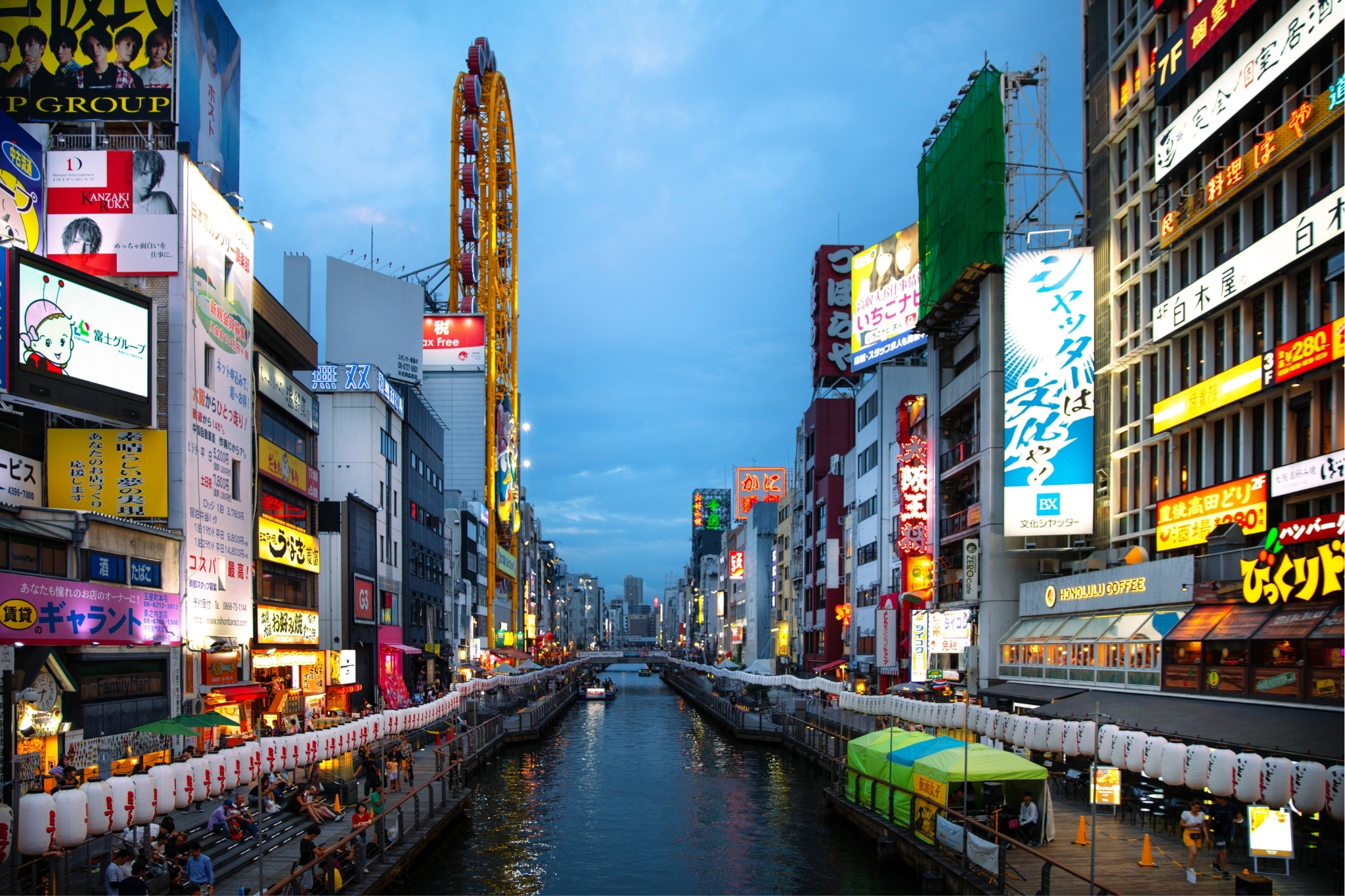
“Dotonbori is easy to photograph badly. Everyone stands on the same bridge, points the same direction, and gets the same flat shot. I walk my clients east first, find a gap in the crowd, and frame the canal so the lights recede. Around 6:45 PM in summer you get this 10-minute window where the sky is exactly the same blue as the canal water. That’s the photo.”
— Banri, Localgrapher photographer in Osaka
2. Osaka Castle Park: The Moat Shot Beats the Top Floor
Osaka Castle is the city’s most visited landmark, a 16th-century fortress rising above a wide stone moat, and it’s one of the most photographed buildings in Japan. But most visitors take one photo of the castle tower from the park entrance and move on. Our Osaka photography team focuses on the moat reflections that most tourists walk straight past.
The Moat's Northeastern Corner at 7:30 AM
The northeastern corner of the inner moat, accessible from the Otemon Gate entrance on the western side of the park (a 12-minute walk from Tanimachi 4-chome Station on the Tanimachi and Chuo lines), gives you a low-angle view of the castle reflecting in still water with zero foot traffic before 8:30 AM. The park itself is open 24 hours and free; castle interior entry costs $7.80 (1,200 yen) per adult. Come before 8:00 AM in any season — tour bus groups arrive between 9:00–10:00 AM and the calm moat surface disappears within minutes of the foot traffic picking up. In spring (late March to early April), the cherry trees lining the outer moat bloom directly behind the moat reflection, creating a pink-framed castle shot that is genuinely unlike anything you can replicate in another season. In autumn (November), the gingko trees turn gold. Bring a wide lens (16–35mm equivalent) and get your tripod low to the moat edge for maximum water reflection. For just the exterior shot, you never need to enter the castle.

Proposal photoshoot by Javier, Localgrapher in Osaka
3. Shinsekai and Tsutenkaku Tower: Retro Osaka, Done Right
Shinsekai is a district that resists the modern Osaka aesthetic entirely. Built in the early 20th century, it is a dense grid of neon-signed restaurant stalls, pachinko parlors, and the 108-meter Tsutenkaku Tower, all compressed into a few city blocks near Shin-Imamiya Station. It photographs like nowhere else in Japan.
The Street-Level Tower Frame, Not the Observation Deck
Walk to the southern end of Tsutenkaku-honmachi covered arcade and look north. At street level, the tower fills the end of the covered shopping street like a postcard prop, with restaurant banners, lanterns, and neon signs layering the foreground. This is the shot, not the view from the top. Best photographed between 4:00–6:00 PM, when soft afternoon light enters the covered street from the west and the neon is already on, creating a natural mix of warm and cool tones. Tower observation deck entry costs $8.20 (1,200 yen) for adults if you want the aerial view, but the street-level composition is stronger for portraits. Come on a weekday afternoon; weekend crowds pack the arcade. For couple portraits, the lane running east of the tower, toward Jannjan横丁 (Janjan Alley), has a narrower, grittier feel with tighter compositions and fewer passersby. A 35mm or 50mm equivalent lens captures the tower and street detail in one frame without distortion.
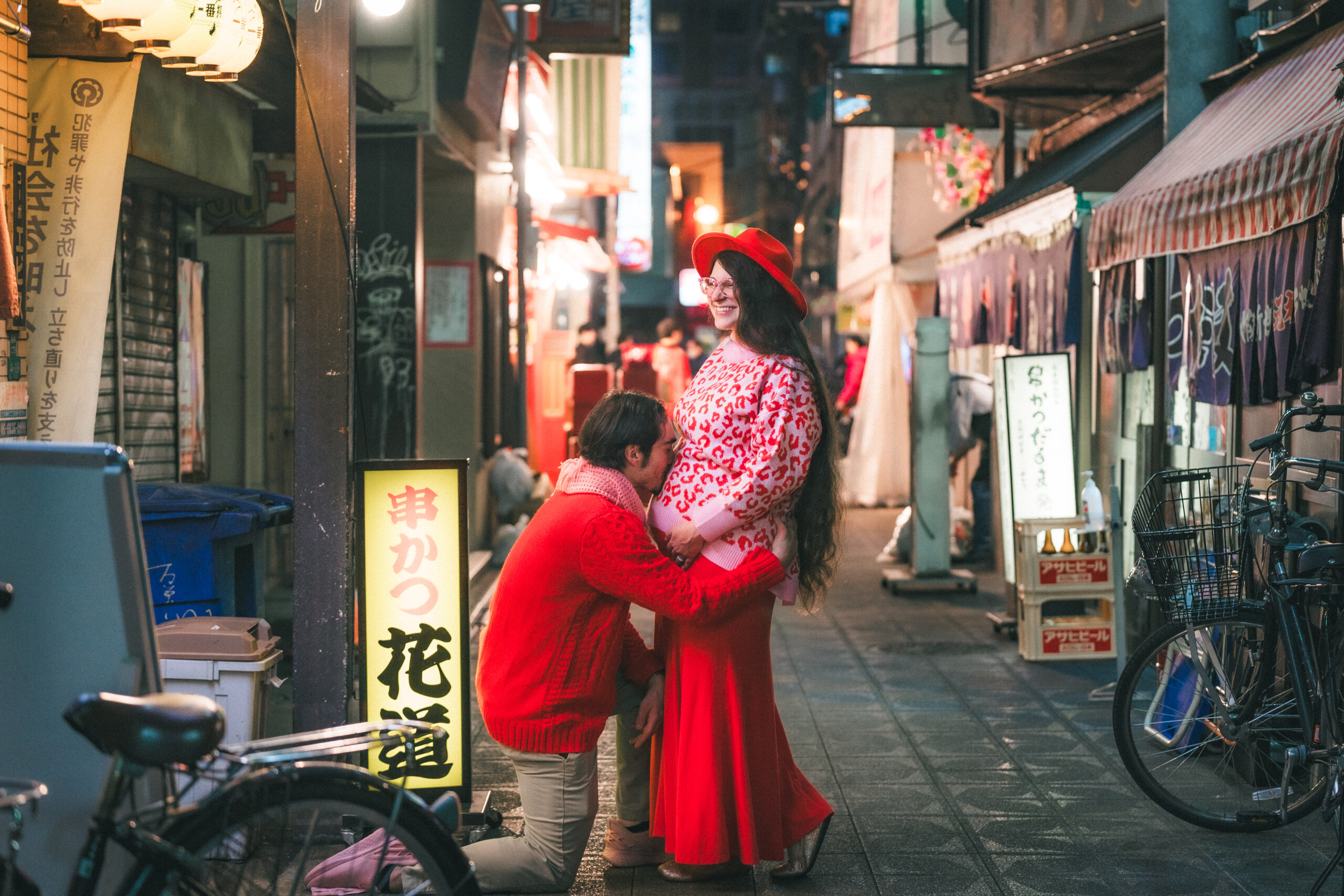
Maternity photoshoot by Daruma, Localgrapher in Osaka
4. Sumiyoshi Taisha Shrine: 1,800 Years of Light on Vermilion
Sumiyoshi Taisha is one of Japan’s oldest Shinto shrines, founded in the 3rd century and home to four main halls designated as National Treasures. It sits in southern Osaka, far enough from the tourist circuit that the average visitor never finds it, but close enough by train to fit easily into a morning shoot. The dramatic Taiko Bashi, a steeply arched stone bridge over a pond, is the most photographically powerful element on the grounds.
The Taiko Bashi Bridge at 7:00 AM, Facing East
Arrive at the shrine outer gate from 6:00 AM (or 6:30 AM between October and March) when it opens. Entry is free. Walk directly to the Taiko Bashi bridge and position yourself on the gravel path on the western bank of the pond, facing east. At 7:00–8:00 AM in spring and summer, the rising sun hits the vermilion of the curved bridge from behind you and reflects in the pond below, creating a double-arch composition that requires almost no editing to be extraordinary. The four main halls behind the bridge are best photographed from the courtyard directly in front of them, where the straight Sumiyoshi-zukuri rooflines create strong horizontal geometry. Take the Nankai Main Line to Sumiyoshitaisha Station (3-minute walk) or the Hankai Tramway to Sumiyoshitoriimae, fare around $1.50 (230 yen) from Tennoji. Arrive before 9:00 AM to have the grounds largely to yourself; New Year periods draw enormous crowds and require completely different timing.

5. Nakazakicho: The Vintage Quarter No Tour Bus Visits
Nakazakicho is a compact neighborhood north of Osaka’s Umeda district where old wooden machiya townhouses have been converted into coffee shops, vintage clothing stores, and small galleries. It looks like 1960s Japan, and it’s the most photogenic residential neighborhood in the city. Our local photographers in Osaka keep this one close.
The Main Alley at 9:00 AM, Before the Café Crowds
The heart of Nakazakicho is a narrow lane running north from Nakazakinishi Station on the Sakaisuji Line (a 1-minute walk from exit 2). The alley itself is roughly 200 meters long and lined with hand-painted shop signs, hanging plants, wooden facades, and the occasional cat. Come at 9:00–10:30 AM on a weekday. The cafés are just opening, the shopkeepers are arranging their displays, and the foot traffic is almost zero. Entry is free. This is not a tripod location, it’s a wide-open prime lens location (35mm or 50mm equivalent), shooting into the morning light coming from the south end of the alley. For couple portraits, the wooden doorways and hanging fabric signs create natural frames without needing any setup. For solo editorial shots, the contrast between vintage architectural detail and a single well-dressed figure is naturally compelling. Skip weekends: the area becomes genuinely busy after 11:00 AM and the alley loses its quiet, intimate feel. The neighborhood between Nakazakicho and Tenjinbashi-suji Shopping Street, about 8 minutes walking north, contains additional side lanes worth exploring before the main shoot.

“Nakazakicho is the location I always protect. Most clients who come to Osaka have never heard of it. You arrive, it’s quiet, the light is perfect because the lanes run north–south, and there are authentic details everywhere you point the lens. Around 9:30 AM on a Tuesday, I had a couple shoot there for 40 minutes and we didn’t see another camera.”
— Javier, Localgrapher photographer in Osaka
6. Umeda Sky Building: The Floating Frame at Dusk
The Umeda Sky Building is a 173-meter twin-tower structure in Osaka’s Kita Ward, connected at the top by a circular open-air observatory called the Kuchu Teien (“Floating Garden”). Its architectural drama comes not from height but from the gap between the two towers, a void that frames the sky and creates compositions unlike any other building in Japan.
The Glass Escalator at Sunset, Then the Observatory After Dark
Take the external glass escalator between floors 35 and 39 between 5:30–6:00 PM (summer) or 4:00–4:30 PM (winter). The escalator is enclosed in glass and ascends through the open air between the two towers, providing a completely different perspective on both the building and the city below. Observatory entry costs $9.70 (1,500 yen) per adult; access the ticket counter at the 39th floor. Open from 9:30 AM to 10:30 PM, last entry 10:00 PM; it is a 7-minute walk from JR Osaka Station’s north exit. The observation deck is open-air on its outer ring, which means wind in winter and clear views year-round. For city photography, the deck’s best angle is northwest, looking over the Yodo River toward the Ikeda hills on clear winter days. For portraits, position your subject against the circular void between the towers at blue hour (around 6:15–6:45 PM in summer, 4:45–5:15 PM in winter) when the sky is deep blue and the city lights below have warmed up. The deck gets crowded on weekends and holidays; weekday evenings have significantly fewer visitors.

7. Hozenji Yokocho: The Hidden Alley Behind Dotonbori
Two minutes from the Dotonbori canal chaos, Hozenji Yokocho is a narrow stone-paved alley with a moss-covered Buddhist statue at its center, surrounded by small traditional restaurants and lanterns. It’s one of the most atmospheric locations in Osaka and one of the least visited by first-time travelers.
The Moss-Covered Fudo Myo-o at 7:00 PM, Lanterns Lit
Hozenji Yokocho runs parallel to Dotonbori canal, accessible from both the Dotonbori side and the Sennichimae arcade side. The central attraction is the Fudo Myo-o statue at Hozenji Temple, whose entire surface is coated in brilliant green moss from centuries of water offerings. This statue is best photographed at 7:00–8:00 PM when the lanterns flanking it are lit, the traffic noise has settled into a low hum, and the incense smoke from visiting worshippers adds atmospheric haze in longer exposures. Entry is free. No tripods are permitted inside the temple area itself, but the alley approaches on either side allow low-to-the-ground compositions with wide lenses that incorporate the lanterns overhead. For portraits, the alley’s stone pavers and warm lantern glow work beautifully for evening couple shoots without any additional lighting. This location pairs naturally with a Dotonbori blue-hour shoot, just 3 minutes away: shoot the canal reflections first, then walk into Hozenji as the lanterns come on.

8. Kuromon Ichiba Market: Texture, Color, and Candid Life
Kuromon Ichiba, nicknamed “Osaka’s Kitchen,” is a 580-meter covered market running south of Nippombashi Station in Namba, packed with fresh seafood stalls, yakitori vendors, fruit displays, and the kind of visual density that rewards a photographer with a telephoto lens. It’s a location that requires a different approach from every other spot on this list.
The Market at 9:00 AM, Shooting Detail Not Overview
Arrive between 9:00–10:30 AM on a weekday. The market opens around 8:00 AM and is at its freshest and most visually active in the first two hours, before the lunch crowds arrive. Entry is free; the covered arcade provides shade and consistent light year-round, making it one of Osaka’s only photogenic indoor street locations. Resist the urge to shoot wide. The most compelling Kuromon images are tight: a whole tuna being sectioned, the gleaming arc of fresh scallops on ice, a vendor’s hand holding a single piece of wagyu. Bring a 50mm or 70–100mm equivalent, get close, and ask permission before photographing vendors directly. A smile and a “shasin, ii desu ka?” (“May I take a photo?”) almost always works). For portraits in the market, position your subject against the color-dense seafood displays in the first third of the arcade nearest the Nippombashi end, where the displays are most visually concentrated. Avoid Saturday afternoons, which draw the heaviest tourist crowds in the week.

“Kuromon is a fundamentally different shoot from everything else in Osaka. You have to slow down, get close, stop trying to capture the whole market and start looking for one perfect frame. The light inside is consistent because of the roof, which means you have time to compose properly. I usually spend 45 minutes there and come out with 20 images worth keeping.”
— Satoshi, Localgrapher photographer in Osaka
9. Tennoji Park and Shitennoji Temple: Ancient and Urban in One Frame
Shitennoji Temple, founded in 593 AD and arguably the oldest Buddhist temple in Japan, sits in the Tennoji district of southern Osaka. Its five-story pagoda and main hall create one of the city’s strongest vertical compositions against the surrounding Abeno Harukas skyscraper to the east, an accidental pairing of ancient and modern that works photographically on every level.
The Western Precinct Gate at 8:30 AM, Pagoda Framed Against Blue Sky
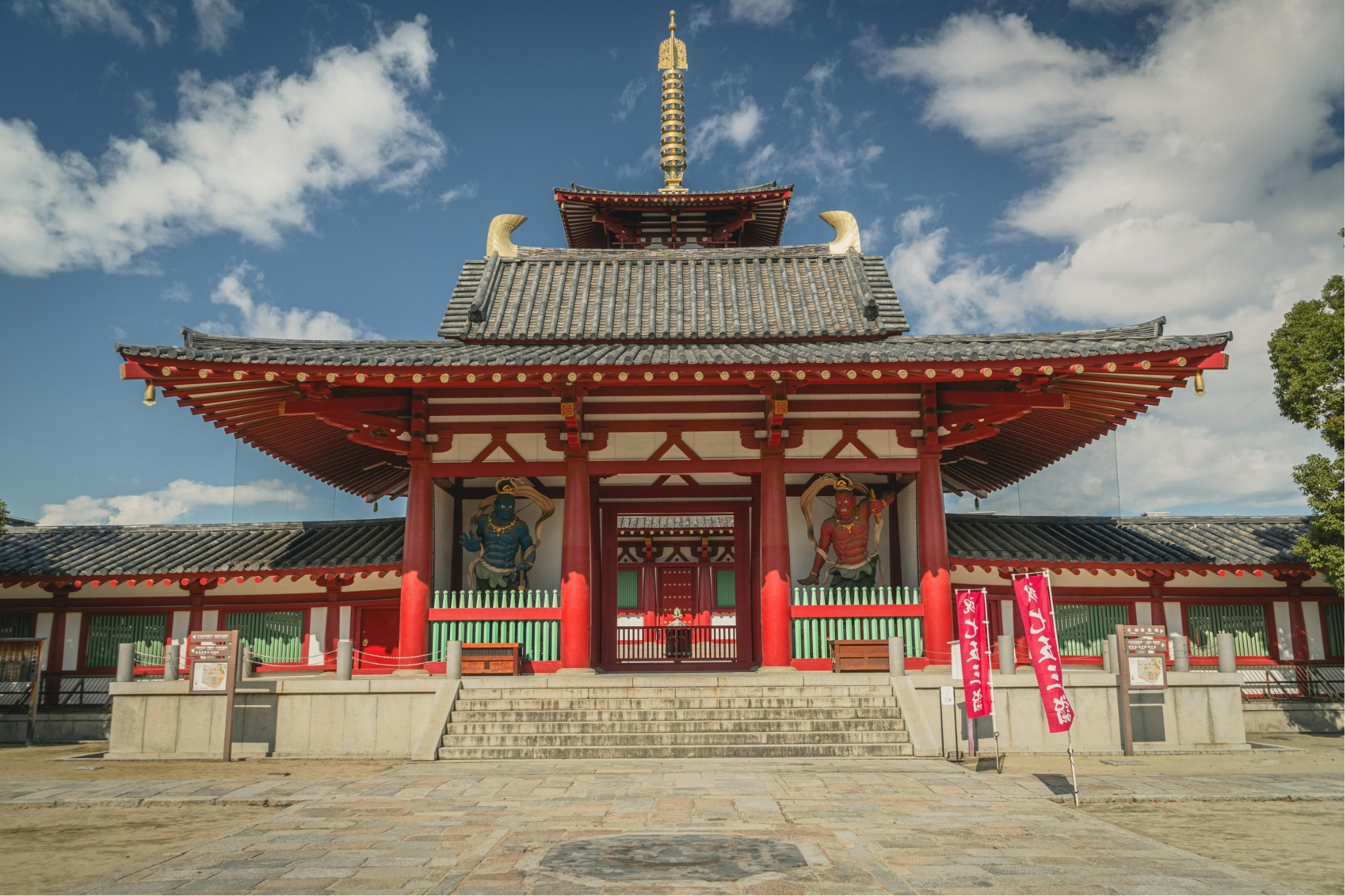
Enter the outer precincts for free from the west (Shitennoji Nishi Gate, a 5-minute walk from Shitennoji-mae Yuhigaoka Station on the Tanimachi Line). The inner precincts, which include the pagoda and main hall, cost $3.20 (500 yen) for adults. The pagoda is best photographed from the courtyard directly in front, using a moderate wide-to-normal lens (24–50mm equivalent), between 8:30–10:00 AM when the light enters from the east and fully illuminates the orange-painted wood against a clear blue sky. The turtle pond in the outer precinct, accessed free of charge, creates a nature frame for the pagoda on its eastern edge and is excellent for family portraits. On Sundays, Shitennoji hosts a popular flea market (gozan-no-ichi on the 21st of each month, a larger event open to antiques and vintage goods) which adds visual richness but also foot traffic. To combine this location efficiently, pair it with Tennoji Park (the adjacent gardens are free) and the Abeno Harukas observation deck next door for a two-hour morning shoot covering temple, garden, and city views.
10. Osaka from Abeno Harukas: The City View That Earns Its Height
At 300 meters, Abeno Harukas is Japan’s tallest skyscraper and its 58–60th floor observatory, Harukas 300, offers the broadest aerial view of Osaka available anywhere in the city. Unlike the more intimate Umeda Sky Building, Harukas frames the entire Osaka–Kobe–Kyoto metropolitan spread in a single panorama on clear days.
The 60th Floor on a Clear Winter Morning Before 10:00 AM
The observatory occupies the top three floors of the building and includes both indoor and outdoor terraces. Entry costs $19.50 (3,000 yen) per adult; the building is directly connected to Tennoji Station (Osaka Metro Tanimachi and Midosuji lines, JR Osaka Loop Line). Open 9:00 AM to 10:00 PM, last entry 9:30 PM. For photography, come on a clear winter weekday morning between 9:00–11:00 AM. The air in December and January has lower humidity than any other season, visibility is highest (on exceptional days you can see Mt. Koya to the south and the Ikoma mountains to the east), and the early morning light from the southeast illuminates the castle park and the Namba district simultaneously. The outdoor terrace on the 58th floor, partially exposed to wind, gives you the cleanest glass-free shot; bring a telephoto (70–200mm equivalent) for isolating the castle and mid-city landmarks from this height. Weekday mornings have significantly lighter crowds than weekends or public holidays. Pairing this with Shitennoji Temple (a 5-minute walk) makes a strong morning itinerary in the Tennoji area without needing public transit between them.

“I bring clients to Harukas when they want context, when they want to understand the scale of Osaka before they go into the streets. Winter mornings are the only time I recommend it, because the city is clear and sharp all the way to the horizon. In summer the haze turns everything soft. On a January morning, you can literally pick out individual buildings from 300 meters and your client finally understands why Osaka is a city worth a week, not two days.”
— Kai, Localgrapher photographer in Osaka
Best Time of Day for Photos in Osaka
Getting the timing right matters more at Osaka photo spots than most cities in Japan because the urban density means light changes fast: a golden window that’s perfect on the canal at 6:30 PM is flat and bleached by 8:00 PM, and the morning window at Sumiyoshi Taisha that looks extraordinary at 7:30 AM is overrun with tour groups by 9:30 AM.
Golden Hour and Season Specifics
**Golden hour (morning):** Sunrise in Osaka occurs around 7:05 AM (December–January) to 4:50 AM (June). The post-sunrise golden hour window runs approximately 45–50 minutes. This is the best window for Osaka Castle moat reflections, Sumiyoshi Taisha, and Nakazakicho.
**Golden hour (evening):** Sunset falls around 4:50 PM (December) to 7:15 PM (June). Blue hour follows for 20–30 minutes. Dotonbori, Hozenji Yokocho, and Umeda Sky Building are at their best in this window.
**Worst light window:** 10:00 AM–3:00 PM year-round. The sun is high, shadows are harsh under faces, and the city’s concrete surfaces reflect glare aggressively. This window is best reserved for indoor locations like Kuromon Market or architectural detail work.
**Season-specific notes:**
- Spring (Mar–Apr): Cherry blossom season is the most photogenic window in the year. Cherry blossoms at Osaka Castle, Kema Sakuranomiya Park along the river, and Tennoji Park transform the city. Book early; photographer availability tightens significantly.
- Early summer (May–Jun): Light quality is crisp and long-lasting; golden hour starts before 5:00 AM in late May. Heat builds from mid-June but mornings remain excellent.
- Summer (Jul–Aug): Harsh midday heat (35°C+), strong humidity, and flattening haze. Stick to 5:00–7:00 AM and evening sessions only. Tenjin Festival in late July adds fireworks over the Okawa River for extraordinary nighttime photography.
- Autumn (Oct–Nov): The second-best season. Gingko trees around Osaka Castle and Shitennoji turn gold in mid-November; temperatures are comfortable; morning light has a warm amber quality that summer never achieves.
- Winter (Dec–Jan): Lowest humidity, sharpest light, and the clearest aerial views from Harukas 300. Christmas illuminations at Namba Parks and Nakanoshima add nighttime options. Crowds at major spots thin out considerably compared to spring.
The hidden advantage of cloudy days: Osaka’s covered arcades (Shinsaibashi-suji, Tenjinbashi-suji) and indoor markets (Kuromon) become even stronger locations on overcast days, because diffused light eliminates the harsh reflections that affect open streets. For portrait work in covered spaces, overcast is better than sunshine. For the full picture on timing, outfits, and what to expect on the day itself, our Osaka photoshoot guide has everything you need before you book.
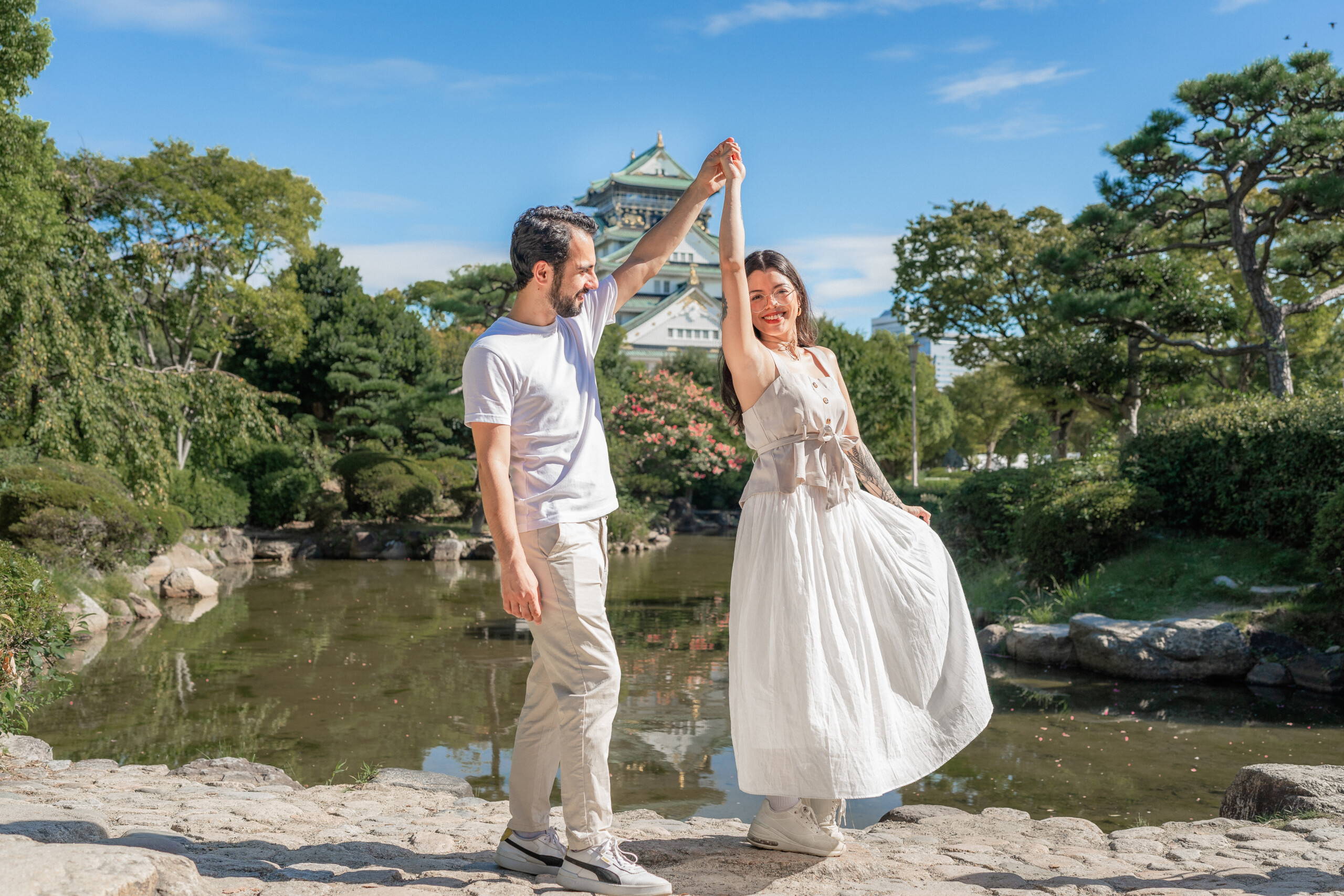
Engagement photoshoot by Daruma, Localgrapher in Osaka
FAQ: Osaka Photo Spots
What are the best photo spots in Osaka?
Among all Osaka photography locations, the ones that deliver the most consistent professional results are Dotonbori at blue hour from the eastern walkway, Osaka Castle moat reflections before 8:30 AM in spring, Shinsekai’s tower street frame in the late afternoon, Sumiyoshi Taisha at sunrise, and Nakazakicho on a weekday morning. For something less visited, Hozenji Yokocho after dark and Kuromon Ichiba Market on weekday mornings are favorites among our local photographers. If you’re looking specifically for Instagram spots in Osaka, Dotonbori’s neon reflections, the Shinsekai tower frame, and the cherry-blossom moat at Osaka Castle are the three that consistently perform best on social.
How do I get to the best Osaka photography locations?
Most central locations are accessible by Osaka Metro for $1.60–$2.60 (250–400 yen) per journey. Dotonbori and Hozenji Yokocho are a 5-minute walk from Namba Station (Midosuji and Sennichimae lines). Osaka Castle is 12 minutes from Tanimachi 4-chome Station. Shinsekai is 2 minutes from Shin-Imamiya Station (Osaka Loop Line) or Dobutsuen-mae Station (Midosuji Line). Sumiyoshi Taisha is a 3-minute walk from Sumiyoshitaisha Station on the Nankai Main Line, about 10 minutes from Namba ($1.50, 230 yen). Our Osaka photographers can meet you at any of these locations and help plan the most efficient route between spots.
When is the best time of year to photograph Osaka?
March through April is the clear answer for most photographers: cherry blossoms at Osaka Castle and Kema Sakuranomiya Park peak in late March to early April, temperatures are 14–20°C (57–68°F), and the morning light is sharp and golden without the summer haze. November is the second-best choice for autumn foliage at the castle and Shitennoji. December and January are the best months for aerial clarity from Harukas 300 and the coldest, crispest blue-hour light over Dotonbori.
How much does an Osaka photoshoot cost?
Packages through Localgrapher start at $280 for a 30-minute Bronze session with 20 edited photos. The most popular choice for couples is the Silver Package at $390 for 60 minutes and 35 edited photos. Gold (100 minutes, 60 photos) is $550 for small groups, and Platinum (120 minutes, 75 photos) is $630 for larger groups. All packages include professional editing and delivery within four business days. For a full pricing breakdown and what’s included, see our Osaka photographer cost guide.
Osaka rewards photographers who plan ahead and understand its dual personality, and the best places for photos in Osaka are: the neon-lit intensity of Dotonbori and the ancient calm of Sumiyoshi Taisha exist 6 kilometers apart and feel like different countries. The best Osaka photo spots, from the canal reflections at blue hour to the moat-framed castle in cherry blossom season and the retro tower silhouettes of Shinsekai, each have a specific window when light and crowd conditions align. With the right Osaka photographer who knows those windows by heart, you stop chasing shots and start walking into them.
Where to take photos in Osaka as a first-time visitor?
If you only have one day, the most efficient first-visit route is: Osaka Castle moat at 7:30 AM, Kuromon Ichiba Market at 9:30 AM, Shinsekai in the late afternoon, and Dotonbori at blue hour around 6:30 PM. That covers historic, market, retro, and neon in a single day with minimal transit between them. All four are on or near the Osaka Metro network and require no entry fees except the castle interior ($7.80, 1,200 yen), which is optional for photography.
Osaka rewards photographers who plan ahead and understand its dual personality. The best places for photos in Osaka, the neon-lit intensity of Dotonbori, the ancient calm of Sumiyoshi Taisha, and the retro tower silhouettes of Shinsekai, each have a specific window when light and crowd conditions align. With the right Osaka photographer who knows those windows by heart, you stop chasing shots and start walking into them.